Friday, June 03, 2005
NTGNTP (6th Draft): CONSIDERATIONS AND DIGRESSIONS Part 2.6.2
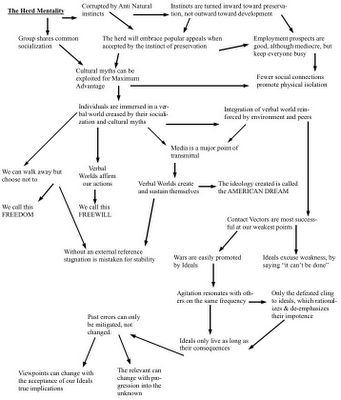
Neither the government nor the population has the best interests of the individual at heart. Lip service means nothing. Their coinage is bankrupt. Their deaths will be well deserved and should be kept final. Their will be no second coming. Martyrdom is for tools. The human herd animal must be largely exterminated by suicide. One need not lift a finger until the final remnants are eliminated. The next step in human cultural evolution will be extremely bloody. Hopefully, this will be the last war. Future fights will be more personal. Humans are social creatures, but the herd is a dead end. The pack will rise again, driving the herd screaming over the cliff face. The leaders will be the last. Their only use is meat. A pack will scatter and regroup for maximum advantage. The herd will huddle. One must find distance, including the manipulation of the slow declining process. Enemies should be encouraged suicidal preemptive errors. Their stupidity will enable this tactic. These people actually believe themselves immune, hence their easy susceptibility. Morality has encouraged overpopulation. The environment might not sustain these numbers. Numbers will mean death. No longer will outside barbarians topple the decadent. These must come from within. Entropy will reign. An individual should see its effects and learn the consequences. The boiling rate can be controlled to a certain degree. Unnatural constraints represent opportunities. Most will believe their reality; the individual will discard those lies. The species can be saved from extinction, but only for a price. Difficult choices must be made, else swallow hemlock and be removed from the problem. The government and population represent the lowest common denominator. The time has come for a new math. Negation is an alternative.


Thursday, June 02, 2005
NTGNTP (6th Draft): CONSIDERATIONS AND DIGRESSIONS Part 2.6.1
6. On the prevention of thuggery:
A widespread collapse will present many challenges. Once all enemies have been broken, measures will be necessary to prevent a degeneration into factionalization and armed thuggery. These must be put down without becoming the enemy while employing the same ruthless spirit and methods. Individual potential must no longer be stifled. Personal destiny is the only true freedom. The new barbarians must smash the remnants of the herd. Cynicism will have a place beyond alienation. Ethics are found lacking in those products of morality. Order must become a limited concept or the cycle will resume. Justice must include the certainty of retaliation, rather than appeals to a higher power. Laws are made to be ignored. Respect must replace fear. The underlying philosophies must be capable of flexibility without breaking. Rigidity only exists for the dead. The lies must be eliminated.
A widespread collapse will present many challenges. Once all enemies have been broken, measures will be necessary to prevent a degeneration into factionalization and armed thuggery. These must be put down without becoming the enemy while employing the same ruthless spirit and methods. Individual potential must no longer be stifled. Personal destiny is the only true freedom. The new barbarians must smash the remnants of the herd. Cynicism will have a place beyond alienation. Ethics are found lacking in those products of morality. Order must become a limited concept or the cycle will resume. Justice must include the certainty of retaliation, rather than appeals to a higher power. Laws are made to be ignored. Respect must replace fear. The underlying philosophies must be capable of flexibility without breaking. Rigidity only exists for the dead. The lies must be eliminated.
Wednesday, June 01, 2005
NTGNTP (6th Draft): CONSIDERATIONS AND DIGRESSIONS Part 2.5.2
The final stages, including open action must wait until the point-of-no-return. The federal authorities will have too many problems. A line will be drawn. The moment for the initial strikes must exploit chaos for maximum advantage. Once the dust settles, all remaining enemies must be treated like cancer and liquidated. Mercy is weakness; hastiness is another. Timing, patience and determination are the corner stones for ultimate victory. Potential megalomaniacs should be treated sacrificially. The death will serve better purpose than their continual existence. Meanwhile, the wait should be spent wisely.
Great satisfaction and even amusement may be had by exploiting and exposing future threats. Let your tax dollars work to destroy control freaks across the political spectrum. Laugh once the system destroys itself. All enemies will get their reward. Factions are particularly vulnerable. The media may be manipulated, hence weakening the system while it destroys all enemies. The stick will not be seen. The media will fall dazed and stunned like a dumb cow. Journalists believe their own self-importance.[37] Let them be the tools they yearn to be. Carpe Diem.
The restraint of outrage will concentrate the power of retaliation. Patience is life.
[37] Their incompetence is truly amazing.
Great satisfaction and even amusement may be had by exploiting and exposing future threats. Let your tax dollars work to destroy control freaks across the political spectrum. Laugh once the system destroys itself. All enemies will get their reward. Factions are particularly vulnerable. The media may be manipulated, hence weakening the system while it destroys all enemies. The stick will not be seen. The media will fall dazed and stunned like a dumb cow. Journalists believe their own self-importance.[37] Let them be the tools they yearn to be. Carpe Diem.
The restraint of outrage will concentrate the power of retaliation. Patience is life.
[37] Their incompetence is truly amazing.
NTGNTP (6th Draft): CONSIDERATIONS AND DIGRESSIONS Part 2.5.1
5. On Megalomaniacs (a Practicality):
Local alliances will form and dissolve once central control has faded. Circumstances and personalities will both play large roles concerning success or failure. Steps must be taken to prevent the ascension of the power mad. Stalin is the only needed argument.[35] Quiet preparation will dissuade the impatient. However, some would surely bide their time for the opportune moment. Meanwhile, information technology can enable communication or create appropriate disinformation. The media is a prime example of a workable system. Propaganda can only be battled with its own mechanisms.[36] These techniques should be studies to enable proper understanding. The machine will rust on its own. Armed rebellion is unnecessary. An open distortion policy might sidetrack conspiracy charges through the typical purge. Any such attempts will require certain methods be exposed and negated. The mirror opposite has more potential being less condemnable (lest a backlash is created). Infiltration is no concern. The stated objective is waiting for a natural decline and fall of the global corporate empire. Most government agencies would find the notion absurd. The government is immortal to those people, even were it to be dust.
[35] Stalin was able to seize power through his office of secretary. He controlled internal information among the fledgling communist party. Hence, Lenin's death-bed warnings concerning him were silenced.
[36] See Jaques Ellul, Propaganda, 1966.
Local alliances will form and dissolve once central control has faded. Circumstances and personalities will both play large roles concerning success or failure. Steps must be taken to prevent the ascension of the power mad. Stalin is the only needed argument.[35] Quiet preparation will dissuade the impatient. However, some would surely bide their time for the opportune moment. Meanwhile, information technology can enable communication or create appropriate disinformation. The media is a prime example of a workable system. Propaganda can only be battled with its own mechanisms.[36] These techniques should be studies to enable proper understanding. The machine will rust on its own. Armed rebellion is unnecessary. An open distortion policy might sidetrack conspiracy charges through the typical purge. Any such attempts will require certain methods be exposed and negated. The mirror opposite has more potential being less condemnable (lest a backlash is created). Infiltration is no concern. The stated objective is waiting for a natural decline and fall of the global corporate empire. Most government agencies would find the notion absurd. The government is immortal to those people, even were it to be dust.
[35] Stalin was able to seize power through his office of secretary. He controlled internal information among the fledgling communist party. Hence, Lenin's death-bed warnings concerning him were silenced.
[36] See Jaques Ellul, Propaganda, 1966.
Tuesday, May 31, 2005
The Society of the Spectacle 165-179
1-15
16-34
35-53
54-72
73-89
90-113
114-124
125-146
147-164
Chapter 7:
Territorial Domination
“Whoever becomes the ruler of a city that is accustomed to freedom and does not destroy it can expect to be destroyed by it, for it can always find a pretext for rebellion in the name of its former freedom and age-old customs, which are never forgotten despite the passage of time or any benefits it has received. No matter what the ruler does or what precautions he takes, the inhabitants will never forget that freedom or those customs — unless they are separated or dispersed . . .”
—Machiavelli, The Prince
165
Capitalist production has unified space, breaking down the boundaries between one society and the next. This unification is at the same time an extensive and intensive process of banalization. Just as the accumulation of commodities mass-produced for the abstract space of the market shattered all regional and legal barriers and all the Medieval guild restrictions that maintained the quality of craft production, it also undermined the autonomy and quality of places. This homogenizing power is the heavy artillery that has battered down all the walls of China.
166
The free space of commodities is constantly being altered and redesigned in order to become ever more identical to itself, to get as close as possible to motionless monotony.
167
While eliminating geographical distance, this society produces a new internal distance in the form of spectacular separation.
168
Tourism — human circulation packaged for consumption, a by-product of the circulation of commodities — is the opportunity to go and see what has been banalized. The economic organization of travel to different places already guarantees their equivalence. The modernization that has eliminated the time involved in travel has simultaneously eliminated any real space from it.
169
The society that reshapes its entire surroundings has evolved its own special technique for molding its own territory, which constitutes the material underpinning for all the facets of this project. Urbanism — “city planning” — is capitalism’s method for taking over the natural and human environment. Following its logical development toward total domination, capitalism now can and must refashion the totality of space into its own particular decor.
170
The capitalist need that is satisfied by urbanism’s conspicuous petrification of life can be described in Hegelian terms as a total predominance of a “peaceful coexistence within space” over “the restless becoming that takes place in the progression of time.”
171
While all the technical forces of capitalism contribute toward various forms of separation, urbanism provides the material foundation for those forces and prepares the ground for their deployment. It is the very technology of separation.
172
Urbanism is the modern method for solving the ongoing problem of safeguarding class power by atomizing workers who have been dangerously brought together by the conditions of urban production. The constant struggle that has had to be waged against anything that might lead to such coming together has found urbanism to be its most effective field of operation. The efforts of all the established powers since the French Revolution to increase the means of maintaining law and order in the streets have finally culminated in the suppression of the street itself. Evoking a “civilization . . . moving along a one-way road,” Lewis Mumford, in The City in History, points out that “with the advent of long-distance mass communications, the isolation of the population has become a much more effective means of control.” But the general trend toward isolation, which is the underlying essence of urbanism, must also include a controlled reintegration of the workers based on the planned needs of production and consumption. This reintegration into the system means bringing isolated individuals together as isolated individuals. Factories, cultural centers, tourist resorts and housing developments are specifically designed to foster this type of pseudocommunity. The same collective isolation prevails even within the family cell, where the omnipresent receivers of spectacular messages fill the isolation with the ruling images — images that derive their full power precisely from that isolation.
173
In all previous periods architectural innovations were designed exclusively for the ruling classes. Now for the first time a new architecture has been specifically designed for the poor. The aesthetic poverty and vast proliferation of this new experience in habitation stem from its mass character, which character in turn stems both from its function and from the modern conditions of construction. The obvious core of these conditions is the authoritarian decisionmaking which abstractly converts the environment into an environment of abstraction. The same architecture appears everywhere as soon as industrialization has begun, even in the countries that are furthest behind in this regard, as an essential foundation for implanting the new type of social existence. The contradiction between the growth of society’s material powers and the continued lack of progress toward any conscious control of those powers is revealed as glaringly by the developments of urbanism as by the issues of thermonuclear weapons or of birth control (where the possibility of manipulating heredity is already on the horizon).
174
The self-destruction of the urban environment is already well under way. The explosion of cities into the countryside, strewing it with what Mumford calls “formless masses of urban debris,” is directly governed by the imperatives of consumption. The dictatorship of the automobile — the pilot product of the first stage of commodity abundance — has left its mark on the landscape with the dominance of freeways, which tear up the old urban centers and promote an ever-wider dispersal. Within this process various forms of partially reconstituted urban fabric fleetingly crystallize around “distribution factories” — giant shopping centers built in the middle of nowhere and surrounded by acres of parking lots. But these temples of frenetic consumption are subject to the same irresistible centrifugal momentum, which casts them aside as soon as they have engendered enough surrounding development to become overburdened secondary centers in their turn. But the technical organization of consumption is only the most visible aspect of the general process of decomposition that has brought the city to the point of consuming itself.
175
Economic history, whose entire previous development centered around the opposition between city and country, has now progressed to the point of nullifying both. As a result of the current paralysis of any historical development beyond the independent movement of the economy, the incipient disappearance of city and country does not represent a transcendence of their separation, but their simultaneous collapse. The mutual erosion of city and country, resulting from the failure of the historical movement through which existing urban reality could have been overcome, is reflected in the eclectic mixture of their decomposed fragments that blanket the most industrialized regions of the world.
176
Universal history was born in cities, and it reached maturity with the city’s decisive victory over the country. For Marx, one of the greatest merits of the bourgeoisie as a revolutionary class was the fact that it “subjected the country to the city,” whose “very air is liberating.” But if the history of the city is a history of freedom, it is also a history of tyranny — a history of state administrations controlling not only the countryside but the cities themselves. The city has served as the historical battleground for the struggle for freedom without yet having been able to win it. The city is the focal point of history because it embodies both a concentration of social power, which is what makes historical enterprises possible, and a consciousness of the past. The current destruction of the city is thus merely one more reflection of humanity’s failure, thus far, to subordinate the economy to historical consciousness; of society’s failure to unify itself by reappropriating the powers that have been alienated from it.
177
“The country represents the complete opposite: isolation and separation” (The German Ideology). As urbanism destroys the cities, it recreates a pseudocountryside devoid both of the natural relations of the traditional countryside and of the direct (and directly challenged) social relations of the historical city. The conditions of habitation and spectacular control in today’s “planned environment” have created an artificial neopeasantry. The geographical dispersal and the narrow-mindedness that have always prevented the peasantry from undertaking independent action and becoming a creative historical force are equally characteristic of these modern producers, for whom a world of their own making is as inaccessible as were the natural rhythms of work in agrarian societies. The peasantry was the steadfast foundation of “Oriental despotism,” in that its inherent fragmentation gave rise to a natural tendency toward bureaucratic centralization. The neopeasantry generated by the increasing bureaucratization of the modern state differs from the old in that its apathy must now be historically manufactured and maintained; natural ignorance has been replaced by the organized spectacle of falsification. The landscape of the “new cities” inhabited by this technological pseudopeasantry is a glaring expression of the repression of historical time on which they have been built. Their motto could be: “Nothing has ever happened here, and nothing ever will.” The forces of historical absence have been able to create their own landscape because historical liberation, which must take place in the cities, has not yet occurred.
178
The history that threatens this twilight world could potentially subject space to a directly experienced time. Proletarian revolution is the critique of human geography through which individuals and communities could create places and events commensurate with the appropriation no longer just of their work, but of their entire history. The ever-changing playing field of this new world and the freely chosen variations in the rules of the game will regenerate a diversity of local scenes that are independent without being insular. And this diversity will revive the possibility of authentic journeys — journeys within an authentic life that is itself understood as a journey containing its whole meaning within itself.
179
The most revolutionary idea concerning urbanism is not itself urbanistic, technological or aesthetic. It is the project of reconstructing the entire environment in accordance with the needs of the power of workers councils, of the antistate dictatorship of the proletariat, of executory dialogue. Such councils can be effective only if they transform existing conditions in their entirety; and they cannot set themselves any lesser task if they wish to be recognized and to recognize themselves in a world of their own making.
16-34
35-53
54-72
73-89
90-113
114-124
125-146
147-164
Chapter 7:
Territorial Domination
“Whoever becomes the ruler of a city that is accustomed to freedom and does not destroy it can expect to be destroyed by it, for it can always find a pretext for rebellion in the name of its former freedom and age-old customs, which are never forgotten despite the passage of time or any benefits it has received. No matter what the ruler does or what precautions he takes, the inhabitants will never forget that freedom or those customs — unless they are separated or dispersed . . .”
—Machiavelli, The Prince
165
Capitalist production has unified space, breaking down the boundaries between one society and the next. This unification is at the same time an extensive and intensive process of banalization. Just as the accumulation of commodities mass-produced for the abstract space of the market shattered all regional and legal barriers and all the Medieval guild restrictions that maintained the quality of craft production, it also undermined the autonomy and quality of places. This homogenizing power is the heavy artillery that has battered down all the walls of China.
166
The free space of commodities is constantly being altered and redesigned in order to become ever more identical to itself, to get as close as possible to motionless monotony.
167
While eliminating geographical distance, this society produces a new internal distance in the form of spectacular separation.
168
Tourism — human circulation packaged for consumption, a by-product of the circulation of commodities — is the opportunity to go and see what has been banalized. The economic organization of travel to different places already guarantees their equivalence. The modernization that has eliminated the time involved in travel has simultaneously eliminated any real space from it.
169
The society that reshapes its entire surroundings has evolved its own special technique for molding its own territory, which constitutes the material underpinning for all the facets of this project. Urbanism — “city planning” — is capitalism’s method for taking over the natural and human environment. Following its logical development toward total domination, capitalism now can and must refashion the totality of space into its own particular decor.
170
The capitalist need that is satisfied by urbanism’s conspicuous petrification of life can be described in Hegelian terms as a total predominance of a “peaceful coexistence within space” over “the restless becoming that takes place in the progression of time.”
171
While all the technical forces of capitalism contribute toward various forms of separation, urbanism provides the material foundation for those forces and prepares the ground for their deployment. It is the very technology of separation.
172
Urbanism is the modern method for solving the ongoing problem of safeguarding class power by atomizing workers who have been dangerously brought together by the conditions of urban production. The constant struggle that has had to be waged against anything that might lead to such coming together has found urbanism to be its most effective field of operation. The efforts of all the established powers since the French Revolution to increase the means of maintaining law and order in the streets have finally culminated in the suppression of the street itself. Evoking a “civilization . . . moving along a one-way road,” Lewis Mumford, in The City in History, points out that “with the advent of long-distance mass communications, the isolation of the population has become a much more effective means of control.” But the general trend toward isolation, which is the underlying essence of urbanism, must also include a controlled reintegration of the workers based on the planned needs of production and consumption. This reintegration into the system means bringing isolated individuals together as isolated individuals. Factories, cultural centers, tourist resorts and housing developments are specifically designed to foster this type of pseudocommunity. The same collective isolation prevails even within the family cell, where the omnipresent receivers of spectacular messages fill the isolation with the ruling images — images that derive their full power precisely from that isolation.
173
In all previous periods architectural innovations were designed exclusively for the ruling classes. Now for the first time a new architecture has been specifically designed for the poor. The aesthetic poverty and vast proliferation of this new experience in habitation stem from its mass character, which character in turn stems both from its function and from the modern conditions of construction. The obvious core of these conditions is the authoritarian decisionmaking which abstractly converts the environment into an environment of abstraction. The same architecture appears everywhere as soon as industrialization has begun, even in the countries that are furthest behind in this regard, as an essential foundation for implanting the new type of social existence. The contradiction between the growth of society’s material powers and the continued lack of progress toward any conscious control of those powers is revealed as glaringly by the developments of urbanism as by the issues of thermonuclear weapons or of birth control (where the possibility of manipulating heredity is already on the horizon).
174
The self-destruction of the urban environment is already well under way. The explosion of cities into the countryside, strewing it with what Mumford calls “formless masses of urban debris,” is directly governed by the imperatives of consumption. The dictatorship of the automobile — the pilot product of the first stage of commodity abundance — has left its mark on the landscape with the dominance of freeways, which tear up the old urban centers and promote an ever-wider dispersal. Within this process various forms of partially reconstituted urban fabric fleetingly crystallize around “distribution factories” — giant shopping centers built in the middle of nowhere and surrounded by acres of parking lots. But these temples of frenetic consumption are subject to the same irresistible centrifugal momentum, which casts them aside as soon as they have engendered enough surrounding development to become overburdened secondary centers in their turn. But the technical organization of consumption is only the most visible aspect of the general process of decomposition that has brought the city to the point of consuming itself.
175
Economic history, whose entire previous development centered around the opposition between city and country, has now progressed to the point of nullifying both. As a result of the current paralysis of any historical development beyond the independent movement of the economy, the incipient disappearance of city and country does not represent a transcendence of their separation, but their simultaneous collapse. The mutual erosion of city and country, resulting from the failure of the historical movement through which existing urban reality could have been overcome, is reflected in the eclectic mixture of their decomposed fragments that blanket the most industrialized regions of the world.
176
Universal history was born in cities, and it reached maturity with the city’s decisive victory over the country. For Marx, one of the greatest merits of the bourgeoisie as a revolutionary class was the fact that it “subjected the country to the city,” whose “very air is liberating.” But if the history of the city is a history of freedom, it is also a history of tyranny — a history of state administrations controlling not only the countryside but the cities themselves. The city has served as the historical battleground for the struggle for freedom without yet having been able to win it. The city is the focal point of history because it embodies both a concentration of social power, which is what makes historical enterprises possible, and a consciousness of the past. The current destruction of the city is thus merely one more reflection of humanity’s failure, thus far, to subordinate the economy to historical consciousness; of society’s failure to unify itself by reappropriating the powers that have been alienated from it.
177
“The country represents the complete opposite: isolation and separation” (The German Ideology). As urbanism destroys the cities, it recreates a pseudocountryside devoid both of the natural relations of the traditional countryside and of the direct (and directly challenged) social relations of the historical city. The conditions of habitation and spectacular control in today’s “planned environment” have created an artificial neopeasantry. The geographical dispersal and the narrow-mindedness that have always prevented the peasantry from undertaking independent action and becoming a creative historical force are equally characteristic of these modern producers, for whom a world of their own making is as inaccessible as were the natural rhythms of work in agrarian societies. The peasantry was the steadfast foundation of “Oriental despotism,” in that its inherent fragmentation gave rise to a natural tendency toward bureaucratic centralization. The neopeasantry generated by the increasing bureaucratization of the modern state differs from the old in that its apathy must now be historically manufactured and maintained; natural ignorance has been replaced by the organized spectacle of falsification. The landscape of the “new cities” inhabited by this technological pseudopeasantry is a glaring expression of the repression of historical time on which they have been built. Their motto could be: “Nothing has ever happened here, and nothing ever will.” The forces of historical absence have been able to create their own landscape because historical liberation, which must take place in the cities, has not yet occurred.
178
The history that threatens this twilight world could potentially subject space to a directly experienced time. Proletarian revolution is the critique of human geography through which individuals and communities could create places and events commensurate with the appropriation no longer just of their work, but of their entire history. The ever-changing playing field of this new world and the freely chosen variations in the rules of the game will regenerate a diversity of local scenes that are independent without being insular. And this diversity will revive the possibility of authentic journeys — journeys within an authentic life that is itself understood as a journey containing its whole meaning within itself.
179
The most revolutionary idea concerning urbanism is not itself urbanistic, technological or aesthetic. It is the project of reconstructing the entire environment in accordance with the needs of the power of workers councils, of the antistate dictatorship of the proletariat, of executory dialogue. Such councils can be effective only if they transform existing conditions in their entirety; and they cannot set themselves any lesser task if they wish to be recognized and to recognize themselves in a world of their own making.
Monday, May 30, 2005
The Society of the Spectacle 147-164
1-15
16-34
35-53
54-72
73-89
90-113
114-124
125-146
Chapter 6:
Spectacular Time
“We have nothing of our own except time, which even the homeless can experience.”
—Baltasar Gracián, The Art of Worldly Wisdom
147
The time of production — commodified time — is an infinite accumulation of equivalent intervals. It is irreversible time made abstract, in which each segment need only demonstrate by the clock its purely quantitative equality with all the others. It has no reality apart from its exchangeability. Under the social reign of commodified time, “time is everything, man is nothing; he is at most the carcass of time” (The Poverty of Philosophy). This devalued time is the complete opposite of time as “terrain of human development.”
148
This general time of human nondevelopment also has a complementary aspect — a consumable form of time based on the present mode of production and presenting itself in everyday life as a pseudocyclical time.
149
This pseudocyclical time is in fact merely a consumable disguise of the production system’s commodified time. It exhibits the latter’s essential traits: homogenous exchangeable units and suppression of any qualitative dimension. But as a by-product of commodified time whose function is to promote and maintain the backwardness of everyday life, it is loaded with pseudovalorizations and manifests itself as a succession of pseudoindividualized moments.
150
Pseudocyclical time is associated with the consumption of modern economic survival — the augmented survival in which everyday experience is cut off from decisionmaking and subjected no longer to the natural order, but to the pseudo-nature created by alienated labor. It is thus quite natural that it echoes the old cyclical rhythm that governed survival in preindustrial societies, incorporating the natural vestiges of cyclical time while generating new variants: day and night, work and weekend, periodic vacations.
151
Pseudocyclical time is a time that has been transformed by industry. The time based on commodity production is itself a consumable commodity, one that recombines everything that the disintegration of the old unitary societies had differentiated into private life, economic life, and political life. The entire consumable time of modern society ends up being treated as a raw material for various new products put on the market as socially controlled uses of time. “A product that already exists in a form suitable for consumption may nevertheless serve as raw material for some other product” (Capital).
152
In its most advanced sectors, concentrated capitalism is increasingly tending to market “fully equipped” blocks of time, each functioning as a unified commodity combining a variety of other commodities. In the expanding economy of “services” and leisure activities, the payment for these blocks of time is equally unified: “everything’s included,” whether it is a matter of spectacular living environments, touristic pseudotravel, subscriptions to cultural consumption, or even the sale of sociability itself in the form of “exciting conversations” and “meetings with celebrities.” Spectacular commodities of this type, which would obviously never sell were it not for the increasing impoverishment of the realities they parody, just as obviously reflect the modernization of sales techniques by being payable on credit.
153
Consumable pseudocyclical time is spectacular time, both in the narrow sense as time spent consuming images and in the broader sense as image of the consumption of time. The time spent consuming images (images which in turn serve to publicize all the other commodities) is both the particular terrain where the spectacle’s mechanisms are most fully implemented and the general goal that those mechanisms present, the focus and epitome of all particular consumptions. Thus, the time that modern society is constantly seeking to “save” by increasing transportation speeds or using packaged soups ends up being spent by the average American in watching television three to six hours a day. As for the social image of the consumption of time, it is exclusively dominated by leisure time and vacations — moments portrayed, like all spectacular commodities, at a distance and as desirable by definition. These commodified moments are explicitly presented as moments of real life whose cyclical return we are supposed to look forward to. But all that is really happening is that the spectacle is displaying and reproducing itself at a higher level of intensity. What is presented as true life turns out to be merely a more truly spectacular life.
154
Although the present age presents itself as a series of frequently recurring festivities, it is an age that knows nothing of real festivals. The moments within cyclical time when members of a community joined together in a luxurious expenditure of life are impossible for a society that lacks both community and luxury. Its vulgarized pseudofestivals are parodies of real dialogue and gift-giving; they may incite waves of excessive economic spending, but they lead to nothing but disillusionments, which can be compensated only by the promise of some new disillusion to come. The less use value is present in the time of modern survival, the more highly it is exalted in the spectacle. The reality of time has been replaced by the publicity of time.
155
While the consumption of cyclical time in ancient societies was consistent with the real labor of those societies, the pseudocyclical consumption of developed economies contradicts the abstract irreversible time implicit in their system of production. Cyclical time was the really lived time of unchanging illusions. Spectacular time is the illusorily lived time of a constantly changing reality.
156
The production process’s constant innovations are not echoed in consumption, which presents nothing but an expanded repetition of the past. Because dead labor continues to dominate living labor, in spectacular time the past continues to dominate the present.
157
The lack of general historical life also means that individual life as yet has no history. The pseudo-events that vie for attention in spectacular dramatizations have not been lived by those who are informed about them; and in any case they are soon forgotten due to their increasingly frenetic replacement at every pulsation of the spectacular machinery. Conversely, what is really lived has no relation to the society’s official version of irreversible time, and conflicts with the pseudocyclical rhythm of that time’s consumable by-products. This individual experience of a disconnected everyday life remains without language, without concepts, and without critical access to its own past, which has nowhere been recorded. Uncommunicated, misunderstood and forgotten, it is smothered by the spectacle’s false memory of the unmemorable.
158
The spectacle, considered as the reigning society’s method for paralyzing history and memory and for suppressing any history based on historical time, represents a false consciousness of time.
159
In order to force the workers into the status of “free” producers and consumers of commodified time, it was first necessary to violently expropriate their time. The imposition of the new spectacular form of time became possible only after this initial dispossession of the producers.
160
The unavoidable biological limitations of the work force — evident both in its dependence on the natural cycle of sleeping and waking and in the debilitating effects of irreversible time over each individual’s lifetime — are treated by the modern production system as strictly secondary considerations. As such, they are ignored in that system’s official proclamations and in the consumable trophies that embody its relentless triumphant progress. Fixated on the delusory center around which his world seems to move, the spectator no longer experiences life as a journey toward fulfillment and toward death. Once he has given up on really living he can no longer acknowledge his own death. Life insurance ads merely insinuate that he may be guilty of dying without having provided for the smooth continuation of the system following the resultant economic loss, while the promoters of the “American way of death” stress his capacity to preserve most of the appearances of life in his post-mortem state. On all the other fronts of advertising bombardment it is strictly forbidden to grow old. Everybody is urged to economize on their “youth-capital,” though such capital, however carefully managed, has little prospect of attaining the durable and cumulative properties of economic capital. This social absence of death coincides with the social absence of life.
161
As Hegel showed, time is the necessary alienation, the terrain where the subject realizes himself by losing himself, becomes other in order to become truly himself. In total contrast, the current form of alienation is imposed on the producers of an estranged present. In this spatial alienation, the society that radically separates the subject from the activity it steals from him is in reality separating him from his own time. This potentially surmountable social alienation is what has prevented and paralyzed the possibilities and risks of a living alienation within time.
162
Behind the fashions that come and go on the frivolous surface of the spectacle of pseudocyclical time, the grand style of an era can always be found in what is governed by the secret yet obvious necessity for revolution.
163
The natural basis of time, the concrete experience of its passage, becomes human and social by existing for humanity. The limitations of human practice imposed by the various stages of labor have humanized time and also dehumanized it, in the forms of cyclical time and of the separated irreversible time of economic production. The revolutionary project of a classless society, of an all-embracing historical life, implies the withering away of the social measurement of time in favor of a federation of independent times — a federation of playful individual and collective forms of irreversible time that are simultaneously present. This would be the temporal realization of authentic communism, which “abolishes everything that exists independently of individuals.”
164
The world already dreams of such a time. In order to actually live it, it only needs to become fully conscious of it.
16-34
35-53
54-72
73-89
90-113
114-124
125-146
Chapter 6:
Spectacular Time
“We have nothing of our own except time, which even the homeless can experience.”
—Baltasar Gracián, The Art of Worldly Wisdom
147
The time of production — commodified time — is an infinite accumulation of equivalent intervals. It is irreversible time made abstract, in which each segment need only demonstrate by the clock its purely quantitative equality with all the others. It has no reality apart from its exchangeability. Under the social reign of commodified time, “time is everything, man is nothing; he is at most the carcass of time” (The Poverty of Philosophy). This devalued time is the complete opposite of time as “terrain of human development.”
148
This general time of human nondevelopment also has a complementary aspect — a consumable form of time based on the present mode of production and presenting itself in everyday life as a pseudocyclical time.
149
This pseudocyclical time is in fact merely a consumable disguise of the production system’s commodified time. It exhibits the latter’s essential traits: homogenous exchangeable units and suppression of any qualitative dimension. But as a by-product of commodified time whose function is to promote and maintain the backwardness of everyday life, it is loaded with pseudovalorizations and manifests itself as a succession of pseudoindividualized moments.
150
Pseudocyclical time is associated with the consumption of modern economic survival — the augmented survival in which everyday experience is cut off from decisionmaking and subjected no longer to the natural order, but to the pseudo-nature created by alienated labor. It is thus quite natural that it echoes the old cyclical rhythm that governed survival in preindustrial societies, incorporating the natural vestiges of cyclical time while generating new variants: day and night, work and weekend, periodic vacations.
151
Pseudocyclical time is a time that has been transformed by industry. The time based on commodity production is itself a consumable commodity, one that recombines everything that the disintegration of the old unitary societies had differentiated into private life, economic life, and political life. The entire consumable time of modern society ends up being treated as a raw material for various new products put on the market as socially controlled uses of time. “A product that already exists in a form suitable for consumption may nevertheless serve as raw material for some other product” (Capital).
152
In its most advanced sectors, concentrated capitalism is increasingly tending to market “fully equipped” blocks of time, each functioning as a unified commodity combining a variety of other commodities. In the expanding economy of “services” and leisure activities, the payment for these blocks of time is equally unified: “everything’s included,” whether it is a matter of spectacular living environments, touristic pseudotravel, subscriptions to cultural consumption, or even the sale of sociability itself in the form of “exciting conversations” and “meetings with celebrities.” Spectacular commodities of this type, which would obviously never sell were it not for the increasing impoverishment of the realities they parody, just as obviously reflect the modernization of sales techniques by being payable on credit.
153
Consumable pseudocyclical time is spectacular time, both in the narrow sense as time spent consuming images and in the broader sense as image of the consumption of time. The time spent consuming images (images which in turn serve to publicize all the other commodities) is both the particular terrain where the spectacle’s mechanisms are most fully implemented and the general goal that those mechanisms present, the focus and epitome of all particular consumptions. Thus, the time that modern society is constantly seeking to “save” by increasing transportation speeds or using packaged soups ends up being spent by the average American in watching television three to six hours a day. As for the social image of the consumption of time, it is exclusively dominated by leisure time and vacations — moments portrayed, like all spectacular commodities, at a distance and as desirable by definition. These commodified moments are explicitly presented as moments of real life whose cyclical return we are supposed to look forward to. But all that is really happening is that the spectacle is displaying and reproducing itself at a higher level of intensity. What is presented as true life turns out to be merely a more truly spectacular life.
154
Although the present age presents itself as a series of frequently recurring festivities, it is an age that knows nothing of real festivals. The moments within cyclical time when members of a community joined together in a luxurious expenditure of life are impossible for a society that lacks both community and luxury. Its vulgarized pseudofestivals are parodies of real dialogue and gift-giving; they may incite waves of excessive economic spending, but they lead to nothing but disillusionments, which can be compensated only by the promise of some new disillusion to come. The less use value is present in the time of modern survival, the more highly it is exalted in the spectacle. The reality of time has been replaced by the publicity of time.
155
While the consumption of cyclical time in ancient societies was consistent with the real labor of those societies, the pseudocyclical consumption of developed economies contradicts the abstract irreversible time implicit in their system of production. Cyclical time was the really lived time of unchanging illusions. Spectacular time is the illusorily lived time of a constantly changing reality.
156
The production process’s constant innovations are not echoed in consumption, which presents nothing but an expanded repetition of the past. Because dead labor continues to dominate living labor, in spectacular time the past continues to dominate the present.
157
The lack of general historical life also means that individual life as yet has no history. The pseudo-events that vie for attention in spectacular dramatizations have not been lived by those who are informed about them; and in any case they are soon forgotten due to their increasingly frenetic replacement at every pulsation of the spectacular machinery. Conversely, what is really lived has no relation to the society’s official version of irreversible time, and conflicts with the pseudocyclical rhythm of that time’s consumable by-products. This individual experience of a disconnected everyday life remains without language, without concepts, and without critical access to its own past, which has nowhere been recorded. Uncommunicated, misunderstood and forgotten, it is smothered by the spectacle’s false memory of the unmemorable.
158
The spectacle, considered as the reigning society’s method for paralyzing history and memory and for suppressing any history based on historical time, represents a false consciousness of time.
159
In order to force the workers into the status of “free” producers and consumers of commodified time, it was first necessary to violently expropriate their time. The imposition of the new spectacular form of time became possible only after this initial dispossession of the producers.
160
The unavoidable biological limitations of the work force — evident both in its dependence on the natural cycle of sleeping and waking and in the debilitating effects of irreversible time over each individual’s lifetime — are treated by the modern production system as strictly secondary considerations. As such, they are ignored in that system’s official proclamations and in the consumable trophies that embody its relentless triumphant progress. Fixated on the delusory center around which his world seems to move, the spectator no longer experiences life as a journey toward fulfillment and toward death. Once he has given up on really living he can no longer acknowledge his own death. Life insurance ads merely insinuate that he may be guilty of dying without having provided for the smooth continuation of the system following the resultant economic loss, while the promoters of the “American way of death” stress his capacity to preserve most of the appearances of life in his post-mortem state. On all the other fronts of advertising bombardment it is strictly forbidden to grow old. Everybody is urged to economize on their “youth-capital,” though such capital, however carefully managed, has little prospect of attaining the durable and cumulative properties of economic capital. This social absence of death coincides with the social absence of life.
161
As Hegel showed, time is the necessary alienation, the terrain where the subject realizes himself by losing himself, becomes other in order to become truly himself. In total contrast, the current form of alienation is imposed on the producers of an estranged present. In this spatial alienation, the society that radically separates the subject from the activity it steals from him is in reality separating him from his own time. This potentially surmountable social alienation is what has prevented and paralyzed the possibilities and risks of a living alienation within time.
162
Behind the fashions that come and go on the frivolous surface of the spectacle of pseudocyclical time, the grand style of an era can always be found in what is governed by the secret yet obvious necessity for revolution.
163
The natural basis of time, the concrete experience of its passage, becomes human and social by existing for humanity. The limitations of human practice imposed by the various stages of labor have humanized time and also dehumanized it, in the forms of cyclical time and of the separated irreversible time of economic production. The revolutionary project of a classless society, of an all-embracing historical life, implies the withering away of the social measurement of time in favor of a federation of independent times — a federation of playful individual and collective forms of irreversible time that are simultaneously present. This would be the temporal realization of authentic communism, which “abolishes everything that exists independently of individuals.”
164
The world already dreams of such a time. In order to actually live it, it only needs to become fully conscious of it.
Sunday, May 29, 2005
NTGNTP (6th Draft): CONSIDERATIONS AND DIGRESSIONS Part 2.4.2
The additional hinderance caused by rebellious local authorities could grind the machine to a halt. Food and fuel would unable to be transported. Any situation impeding cheap energy would handicap military efforts once national reserves were exhausted. Destroying sections of the interstate and regional highway system would paralyze the continent. This nation was built on cheap resources, necessitating such actions as the 1991 Gulf War. A civil war could erupt along regional lines. Unity would evaporate with creature comforts. The United States could follow the world wide trend toward balkinization.[34] Technology might drive apart by promoting decadent isolation where few care about their neighbors. Trade no longer requires personnel contact. Perhaps the situation will come full circle -- provided anyone survives.
[34] World government will not be a reality anytime soon, except along economic lines. The United Nations is a poor joke.
[34] World government will not be a reality anytime soon, except along economic lines. The United Nations is a poor joke.
Saturday, May 28, 2005
NTGNTP (6th Draft): CONSIDERATIONS AND DIGRESSIONS Part 2.4.1
4. Regarding Martial Law:
In response to massive civil unrest, the military is always called upon to augment law enforcement and quell disturbances. The 1992 Los Angeles riots were handled in this manner. A truly national disturbance would even tax the military. Uncooperative local police forces could seriously hinder or even undermine those efforts. Many troops would resent their role, thereby causing dissension in the ranks as they were pushed to full police duty. The military has always played a backing role, and would find itself unprepared for primacy. The lack of local intelligence would cause headaches. Military personnel would not be employed anywhere with local connections due to possible sympathies. Strong arm tactics would halt trade, worsening the crisis. The lone military would prove ineffective.
In response to massive civil unrest, the military is always called upon to augment law enforcement and quell disturbances. The 1992 Los Angeles riots were handled in this manner. A truly national disturbance would even tax the military. Uncooperative local police forces could seriously hinder or even undermine those efforts. Many troops would resent their role, thereby causing dissension in the ranks as they were pushed to full police duty. The military has always played a backing role, and would find itself unprepared for primacy. The lack of local intelligence would cause headaches. Military personnel would not be employed anywhere with local connections due to possible sympathies. Strong arm tactics would halt trade, worsening the crisis. The lone military would prove ineffective.
Friday, May 27, 2005
NTGNTP (6th Draft): CONSIDERATIONS AND DIGRESSIONS Part 2.3.0
The resultant misery brought about by a governmental collapse must be regarded being completely undesirable. Participation in the few remaining open processes might ease or negate some consequences. One must not be above utilizing channels or offices for these ends. Idealism is a luxury employed by losers. Resource allocation could eventually prove crucial. Sustained anarchy is a fantasy. The power vacuum will be filled. All majorities will be able to enforce their will unchecked. The constitution will be only so many words. Inequality will finally be a reality. One will be forced to protect rights. The question: True freedom or another form of slavery?
Thursday, May 26, 2005
NTGNTP (6th Draft): CONSIDERATIONS AND DIGRESSIONS Part 2.2.0
i. All cops are not swine;
ii. All criminals are not victims.
ii. All criminals are not victims.
Wednesday, May 25, 2005
NTGNTP (6th Draft): CONSIDERATIONS AND DIGRESSIONS Part 2.1.7
Any contemporary coup or revolt would be swatted like a fly,
then exploited for maximum advantage by propaganda. Examples will be made to the fullest extent possible. Mcvey's executions will offer an opportunity greater than his trial. Sedition is currently not possible. Technologies, designed to fight nuclear war, have been directed internally. This might be lessened over time. Individuals may accomplish much with ever cheaper tools. The system will rot from within. Stasis is not maintainable. Let the reactionary commit suicide. Tax dollars have never been better spent: a fitting end for patriots. These people waved flags celebrating other crushing defeats. Their enthusiasm seems waning... Dinosaurs should be extinct. Avoid purges and wait. Contacts with local law enforcement may prove beneficial, including the removal of certain records...
Alternatives are not rote.
then exploited for maximum advantage by propaganda. Examples will be made to the fullest extent possible. Mcvey's executions will offer an opportunity greater than his trial. Sedition is currently not possible. Technologies, designed to fight nuclear war, have been directed internally. This might be lessened over time. Individuals may accomplish much with ever cheaper tools. The system will rot from within. Stasis is not maintainable. Let the reactionary commit suicide. Tax dollars have never been better spent: a fitting end for patriots. These people waved flags celebrating other crushing defeats. Their enthusiasm seems waning... Dinosaurs should be extinct. Avoid purges and wait. Contacts with local law enforcement may prove beneficial, including the removal of certain records...
Alternatives are not rote.
Tuesday, May 24, 2005
NTGNTP (6th Draft): CONSIDERATIONS AND DIGRESSIONS Part 2.1.6
As the economy slowly sinks further into a debt quagmire and better wage jobs move elsewhere, the average standard of living will decrease accordingly. A breaking point would probably center around an un-mitigated currency crisis. Many other factors would certainly contribute. The broken back of the power elite may unleash a brief period of anarchy. Less pleasant factions will need to be fought off. Any remaining far-right supporters will be long weakened and easily swept away. The power vacuum will be filled by support of either the remaining police or military. The lesser evil is idealistically unappealing. However, reality is another matter. Civil law is preferable to martial law.
Monday, May 23, 2005
NTGNTP (6th Draft): CONSIDERATIONS AND DIGRESSIONS Part 2.1.5
Note: I call this a draft for good reason.
The federal government is a massive societal support system. Many benefits are incurred. The majority would suffer greatly were it to collapse. Most would never support a violent overthrow for these reasons alone. Circumstances could change in another few generations with its degeneration. A global debt-ridden economy could provide enough sentiment along regional lines. Big brother's pockets run deep, but a global depression might prove impossible to overcome. Entropy must affect all closed systems. The world population will eventually peak. Once the global economy is integrated and cannot expand, the analogous thermodynamic condition will occur. Disorder will gradually increase to crisis levels hitherto unseen. In the United States any significant militant movements will have been crushed. Their existence will be historical curiosity, except possibly lukewarm environmentalism.[33] The willfully patient may be the only prepared. Hence, the individual might seize the moment. A few worthy allies could prove crucial.
[33] Unless debatable global warming or significant ozone depletion becomes a noticeable reality. Even propaganda might not adequately quell resentment.
The federal government is a massive societal support system. Many benefits are incurred. The majority would suffer greatly were it to collapse. Most would never support a violent overthrow for these reasons alone. Circumstances could change in another few generations with its degeneration. A global debt-ridden economy could provide enough sentiment along regional lines. Big brother's pockets run deep, but a global depression might prove impossible to overcome. Entropy must affect all closed systems. The world population will eventually peak. Once the global economy is integrated and cannot expand, the analogous thermodynamic condition will occur. Disorder will gradually increase to crisis levels hitherto unseen. In the United States any significant militant movements will have been crushed. Their existence will be historical curiosity, except possibly lukewarm environmentalism.[33] The willfully patient may be the only prepared. Hence, the individual might seize the moment. A few worthy allies could prove crucial.
[33] Unless debatable global warming or significant ozone depletion becomes a noticeable reality. Even propaganda might not adequately quell resentment.
Sunday, May 22, 2005
Saturday, May 21, 2005
The Society of the Spectacle 125-146
1-15
16-34
35-53
54-72
73-89
90-113
114-124
Chapter 5:
Time and History
O, gentlemen, the time of life is short! . . .
An if we live, we live to tread on kings.
—Shakespeare, Henry IV, Part I
125
Man, “the negative being who is solely to the extent that he suppresses Being,” is one with time. Man’s appropriation of his own nature is at the same time his grasp of the development of the universe. “History is itself a real part of natural history, of the transformation of nature into man” (Marx). Conversely, this “natural history” has no real existence other than through the process of human history, the only vantage point from which one can take in that historical totality (like the modern telescope whose power enables one to look back in time at the receding nebulas at the periphery of the universe). History has always existed, but not always in its historical form. The temporalization of humanity, brought about through the mediation of a society, amounts to a humanization of time. The unconscious movement of time becomes manifest and true within historical consciousness.
126
True (though still hidden) historical movement begins with the slow and imperceptible development of the “real nature of man” — the “nature that is born with human history, out of the generative action of human society.” But even when such a society has developed a technology and a language and is already a product of its own history, it is conscious only of a perpetual present. Knowledge is carried on only by the living, never going beyond the memory of the society’s oldest members. Neither death nor procreation is understood as a law of time. Time remains motionless, like an enclosed space. When a more complex society finally becomes conscious of time, it tries to negate it — it views time not as something that passes, but as something that returns. This static type of society organizes time in a cyclical manner, in accordance with its own direct experience of nature.
127
Cyclical time is already dominant among the nomadic peoples because they find the same conditions repeated at each moment of their journey. As Hegel notes, “the wandering of nomads is only nominal because it is limited to uniform spaces.” When a society settles in a particular location and gives space a content by developing distinctive areas within it, it finds itself confined within that locality. The periodic return to similar places now becomes the pure return of time in the same place, the repetition of a sequence of activities. The transition from pastoral nomadism to sedentary agriculture marks the end of an idle and contentless freedom and the beginning of labor. The agrarian mode of production, governed by the rhythm of the seasons, is the basis for fully developed cyclical time. Eternity is within this time, it is the return of the same here on earth. Myth is the unitary mental construct which guarantees that the cosmic order conforms with the order that this society has in fact already established within its frontiers.
128
The social appropriation of time and the production of man by human labor develop within a society divided into classes. The power that establishes itself above the poverty of the society of cyclical time, the class that organizes this social labor and appropriates its limited surplus value, simultaneously appropriates the temporal surplus value resulting from its organization of social time: it alone possesses the irreversible time of the living. The wealth that can only be concentrated in the hands of the rulers and spent in extravagant festivities is also spent as a squandering of historical time at the surface of society. The owners of this historical surplus value are the only ones in a position to know and enjoy real events. Separated from the collective organization of time associated with the repetitive production at the base of social life, this historical time flows independently above its own static community. This is the time of adventure and war, the time in which the masters of cyclical society pursue their personal histories; it is also the time that emerges in the clashes with foreign communities that disrupt the unchanging social order. History thus arises as something alien to people, as something they never sought and from which they had thought themselves protected. But it also revives the negative human restlessness that had been at the very origin of this whole (temporarily suspended) development.
129
In itself, cyclical time is a time without conflict. But conflict is already present even in this infancy of time, as history first struggles to become history in the practical activity of the masters. This history creates a surface irreversibility; its movement constitutes the very time it uses up within the inexhaustible time of cyclical society.
130
“Static societies” are societies that have reduced their historical movement to a minimum and that have managed to maintain their internal conflicts and their conflicts with the natural and human environment in a constant equilibrium. Although the extraordinary diversity of the institutions established for this purpose bears eloquent testimony to the flexibility of human nature’s self-creation, this diversity is apparent only to the external observer, the anthropologist who looks back from the vantage point of historical time. In each of these societies a definitive organizational structure has eliminated any possibility of change. The total conformism of their social practices, with which all human possibilities are identified for all time, has no external limit but the fear of falling back into a formless animal condition. The members of these societies remain human at the price of always remaining the same.
131
With the emergence of political power — which seems to be associated with the last great technological revolutions (such as iron smelting) at the threshold of a period that would experience no further major upheavals until the rise of modern industry — kinship ties begin to dissolve. The succession of generations within a natural, purely cyclical time begins to be replaced by a linear succession of powers and events. This irreversible time is the time of those who rule, and the dynasty is its first unit of measurement. Writing is the rulers’ weapon. In writing, language attains its complete independence as a mediation between consciousnesses. But this independence coincides with the independence of separate power, the mediation that shapes society. With writing there appears a consciousness that is no longer carried and transmitted directly among the living — an impersonal memory, the memory of the administration of society. “Writings are the thoughts of the state; archives are its memory” (Novalis).
132
The chronicle is the expression of the irreversible time of power. It also serves to inspire the continued progression of that time by recording the past out of which it has developed, since this orientation of time tends to collapse with the fall of each particular power and would otherwise sink back into the indifferent oblivion of cyclical time (the only time known to the peasant masses who, during the rise and fall of all the empires and their chronologies, never change). The owners of history have given time a direction, a direction which is also a meaning. But this history develops and perishes separately, leaving the underlying society unchanged, because it remains separated from the common reality. This is why we tend to reduce the history of Oriental empires to a history of religions: the chronologies that have fallen to ruins have left nothing but the seemingly independent history of the illusions that veiled them. The masters who used the protection of myth to make history their private property did so first of all in the realm of illusion. In China and Egypt, for example, they long held a monopoly on the immortality of the soul; and their earliest officially recognized dynasties were nothing but imaginary reconstructions of the past. But this illusory ownership by the masters was the only ownership then possible, both of the common history and of their own history. As their real historical power expanded, this illusory-mythical ownership became increasingly vulgarized. All these consequences flowed from the simple fact that as the masters played the role of mythically guaranteeing the permanence of cyclical time (as in the seasonal rites performed by the Chinese emperors), they themselves achieved a relative liberation from cyclical time.
133
The dry, unexplained chronology that a deified authority offered to its subjects, who were supposed to accept it as the earthly fulfillment of mythic commandments, was destined to be transcended and transformed into conscious history. But for this to happen, sizeable groups of people had to have experienced real participation in history. Out of this practical communication between those who have recognized each other as possessors of a unique present, who have experienced a qualitative richness of events in their own activity and who are at home in their own era, arises the general language of historical communication. Those for whom irreversible time truly exists discover in it both the memorable and the threat of oblivion: “Herodotus of Halicarnassus here presents the results of his researches, so that time will not abolish the deeds of men. . . .”
134
Examining history amounts to examining the nature of power. Greece was the moment when power and changes in power were first debated and understood. It was a democracy of the masters of society — a total contrast to the despotic state, where power settles accounts only with itself, within the impenetrable obscurity of its inner sanctum, by means of palace revolutions, which are beyond the pale of discussion whether they fail or succeed. But the shared power in the Greek communities was limited to the consumption of a social life whose production remained the separate and static domain of the servile class. The only people who lived were those who did not work. The divisions among the Greek communities and their struggles to exploit foreign cities were the externalized expression of the principle of separation on which each of them was based internally. Although Greece had dreamed of universal history, it did not succeed in unifying itself in the face of foreign invasion, or even in unifying the calendars of its independent city-states. Historical time became conscious in Greece, but it was not yet conscious of itself.
135
The disappearance of the particular conditions that had favored the Greek communities brought about a regression of Western historical thought, but it did not lead to a restoration of the old mythic structures. The clashes of the Mediterranean peoples and the rise and fall of the Roman state gave rise instead to semihistorical religions, which became a new armor for separate power and basic components of a new consciousness of time.
136
The monotheistic religions were a compromise between myth and history, between the cyclical time that still governed the sphere of production and the irreversible time that was the theater of conflicts and regroupings among different peoples. The religions that evolved out of Judaism were abstract universal acknowledgments of an irreversible time that had become democratized and open to all, but only in the realm of illusion. Time is totally oriented toward a single final event: “The Kingdom of God is soon to come.” These religions were rooted in the soil of history, but they remained radically opposed to history. The semihistorical religions establish a qualitative point of departure in time (the birth of Christ, the flight of Mohammed), but their irreversible time — introducing an accumulation that would take the form of conquest in Islam and of increasing capital in Reformation Christianity — is inverted in religious thought and becomes a sort of countdown: waiting for time to run out before the Last Judgment and the advent of the other, true world. Eternity has emerged from cyclical time, as something beyond it. It is also the element that restrains the irreversibility of time, suppressing history within history itself by positioning itself on the other side of irreversible time as a pure point into which cyclical time returns and disappears. Bossuet will still say: “By way of time, which passes, we enter eternity, which does not pass.”
137
The Middle Ages, an incomplete mythical world whose consummation lay outside itself, is the period when cyclical time, though still governing the major part of production, really begins to be undermined by history. An element of irreversible time is recognized in the successive stages of each individual’s life. Life is seen as a one-way journey through a world whose meaning lies elsewhere: the pilgrim is the person who leaves cyclical time behind and actually becomes the traveler that everyone else is symbolically. Personal historical life still finds its fulfillment within the sphere of power, whether in struggles waged by power or in struggles over disputed power; but power’s irreversible time is now shared to an unlimited degree due to the general unity brought about by the oriented time of the Christian Era — a world of armed faith, where the adventures of the masters revolve around fealty and disputes over who owes fealty to whom. Feudal society was born from the merging of “the organizational structures of the conquering armies that developed in the process of conquest” with “the productive forces found in the conquered regions” (The German Ideology), and the factors contributing to the organization of those productive forces include the religious language in which they were expressed. Social domination was divided between the Church and the state, the latter power being in turn subdivided in the complex relations of suzerainty and vassalage within and between rural domains and urban communities. This diversification of potential historical life reflected the gradual emergence (following the failure of that great official enterprise of the medieval world, the Crusades) of the era’s unnoticed innovation: the irreversible time that was silently undermining the society, the time experienced by the bourgeoisie in the production of commodities, the foundation and expansion of cities, and the commercial discovery of the planet — a practical experimentation that destroyed any mythical organization of the cosmos once and for all.
138
With the waning of the Middle Ages, the irreversible time that had invaded society was experienced by a consciousness still attached to the old order as an obsession with death. This was the melancholy of a world passing away, the last world where the security of myth still counterbalanced history; and for this melancholy all earthly things move inevitably toward decay. The great European peasant revolts were also an attempt to respond to history — a history that was violently wresting the peasants from the patriarchal slumber that had been imposed by their feudal guardians. The millenarians’ utopian aspiration of creating heaven on earth revived a dream that had been at the origin of the semihistorical religions, when the early Christian communities, like the Judaic messianism from which they sprung, responded to the troubles and misfortunes of their time by envisioning the imminent realization of the Kingdom of God, thereby adding an element of unrest and subversion to ancient society. When Christianity reached the point of sharing power within the empire, it denounced whatever still remained of this hope as mere superstition. This is what St. Augustine was doing when, in a formula that can be seen as the archetype of all the modern ideological apologetics, he declared that the Kingdom of God had in fact already come long ago — that it was nothing other than the established Church. The social revolts of the millenarian peasantry naturally began by defining their goal as the overthrow of that Church. But millenarianism developed in a historical world, not on the terrain of myth. Modern revolutionary expectations are not irrational continuations of the religious passion of millenarianism, as Norman Cohn thought he had demonstrated in The Pursuit of the Millennium. On the contrary, millenarianism, revolutionary class struggle speaking the language of religion for the last time, was already a modern revolutionary tendency, a tendency that lacked only the consciousness that it was a purely historical movement. The millenarians were doomed to defeat because they were unable to recognize their revolution as their own undertaking. The fact that they hesitated to act until they had received some external sign of God’s will was an ideological corollary to the insurgent peasants’ practice of following leaders from outside their own ranks. The peasant class could not attain a clear understanding of the workings of society or of how to conduct its own struggle, and because it lacked these conditions for unifying its action and consciousness, it expressed its project and waged its wars with the imagery of an earthly paradise.
139
The Renaissance was a joyous break with eternity. Though seeking its heritage and legitimacy in the ancient world, it represented a new form of historical life. Its irreversible time was that of a never-ending accumulation of knowledge, and the historical consciousness engendered by the experience of democratic communities and of the forces that destroy them now took up once again, with Machiavelli, the analysis of secularized power, saying the previously unsayable about the state. In the exuberant life of the Italian cities, in the creation of festivals, life is experienced as an enjoyment of the passage of time. But this enjoyment of transience is itself transient. The song of Lorenzo de’ Medici, which Burckhardt considered “the very spirit of the Renaissance,” is the eulogy this fragile historical festival delivers on itself: “How beautiful the spring of life — and how quickly it vanishes.”
140
The constant tendency toward the monopolization of historical life by the absolute-monarchist state — a transitional form on the way to complete domination by the bourgeois class — brings into clear view the nature of the bourgeoisie’s new type of irreversible time. The bourgeoisie is associated with a labor time that has finally been freed from cyclical time. With the bourgeoisie, work becomes work that transforms historical conditions. The bourgeoisie is the first ruling class for which work is a value. And the bourgeoisie, which suppresses all privilege and recognizes no value that does not stem from the exploitation of labor, has appropriately identified its own value as a ruling class with labor, and has made the progress of labor the measure of its own progress. The class that accumulates commodities and capital continually modifies nature by modifying labor itself, by unleashing labor’s productivity. At the stage of absolute monarchy, all social life was already concentrated within the ornamented poverty of the Court, the gaudy trappings of a bleak state administration whose apex was the “profession of king”; and all particular historical freedoms had to surrender to this new power. The free play of the feudal lords’ irreversible time came to an end in their last, lost battles — in the Fronde and in the Scottish uprising in support of Bonny Prince Charlie. The world now had a new foundation.
141
The victory of the bourgeoisie is the victory of a profoundly historical time, because it is the time corresponding to an economic production that continuously transforms society from top to bottom. So long as agrarian production remains the predominant form of labor, the cyclical time that remains at the base of society reinforces the joint forces of tradition, which tend to hold back any historical movement. But the irreversible time of the bourgeois economy eradicates those vestiges throughout the world. History, which until then had seemed to involve only the actions of individual members of the ruling class, and which had thus been recorded as a mere chronology of events, is now understood as a general movement — a relentless movement that crushes any individuals in its path. By discovering its basis in political economy, history becomes aware of what had previously been unconscious; but this basis remains unconscious because it cannot be brought to light. This blind prehistory, this new fate that no one controls, is the only thing that the commodity economy has democratized.
142
The history that is present in all the depths of society tends to become invisible at the surface. The triumph of irreversible time is also its metamorphosis into a time of things, because the weapon that brought about its victory was the mass production of objects in accordance with the laws of the commodity. The main product that economic development has transformed from a luxurious rarity to a commonly consumed item is thus history itself — but only in the form of the history of the abstract movement of things that dominates all qualitative aspects of life. While the earlier cyclical time had supported an increasing degree of historical time lived by individuals and groups, the irreversible time of production tends to socially eliminate such lived time.
143
The bourgeoisie has thus made irreversible historical time known and has imposed it on society, but it has prevented society from using it. “Once there was history, but not any more,” because the class of owners of the economy, which is inextricably tied to economic history, must repress every other irreversible use of time because it is directly threatened by them all. The ruling class, made up of specialists in the possession of things who are themselves therefore possessed by things, is forced to link its fate with the preservation of this reified history, that is, with the preservation of a new immobility within history. Meanwhile the worker at the base of society is for the first time not materially estranged from history, because the irreversible movement is now generated from that base. By demanding to live the historical time that it produces, the proletariat discovers the simple, unforgettable core of its revolutionary project; and each previously defeated attempt to carry out this project represents a possible point of departure for a new historical life.
144
The irreversible time of the bourgeoisie that had just seized power was at first called by its own name and assigned an absolute origin: Year One of the Republic. But the revolutionary ideology of general freedom that had served to overthrow the last remnants of a myth-based ordering of values, along with all the traditional forms of social organization, was already unable to completely conceal the real goal that it had draped in Roman costume: unrestricted freedom of trade. Commodity society, discovering its need to restore the passivity that it had so profoundly shaken in order to establish its own unchallenged rule, now found that, for its purposes, “Christianity with its cult of man in the abstract . . . is the most fitting form of religion” (Capital). The bourgeoisie thus entered into a compromise with that religion, a compromise reflected in its presentation of time: the Revolutionary calendar was abandoned and irreversible time returned to the straitjacket of a duly extended Christian Era.
145
With the development of capitalism, irreversible time has become globally unified. Universal history becomes a reality because the entire world is brought under the sway of this time’s development. But this history that is everywhere simultaneously the same is as yet nothing but an intrahistorical rejection of history. What appears the world over as the same day is merely the time of economic production, time cut up into equal abstract fragments. This unified irreversible time belongs to the global market, and thus also to the global spectacle.
146
The irreversible time of production is first of all the measure of commodities. The time officially recognized throughout the world as the general time of society actually only reflects the specialized interests that constitute it, and thus is merely one particular type of time.
16-34
35-53
54-72
73-89
90-113
114-124
Chapter 5:
Time and History
O, gentlemen, the time of life is short! . . .
An if we live, we live to tread on kings.
—Shakespeare, Henry IV, Part I
125
Man, “the negative being who is solely to the extent that he suppresses Being,” is one with time. Man’s appropriation of his own nature is at the same time his grasp of the development of the universe. “History is itself a real part of natural history, of the transformation of nature into man” (Marx). Conversely, this “natural history” has no real existence other than through the process of human history, the only vantage point from which one can take in that historical totality (like the modern telescope whose power enables one to look back in time at the receding nebulas at the periphery of the universe). History has always existed, but not always in its historical form. The temporalization of humanity, brought about through the mediation of a society, amounts to a humanization of time. The unconscious movement of time becomes manifest and true within historical consciousness.
126
True (though still hidden) historical movement begins with the slow and imperceptible development of the “real nature of man” — the “nature that is born with human history, out of the generative action of human society.” But even when such a society has developed a technology and a language and is already a product of its own history, it is conscious only of a perpetual present. Knowledge is carried on only by the living, never going beyond the memory of the society’s oldest members. Neither death nor procreation is understood as a law of time. Time remains motionless, like an enclosed space. When a more complex society finally becomes conscious of time, it tries to negate it — it views time not as something that passes, but as something that returns. This static type of society organizes time in a cyclical manner, in accordance with its own direct experience of nature.
127
Cyclical time is already dominant among the nomadic peoples because they find the same conditions repeated at each moment of their journey. As Hegel notes, “the wandering of nomads is only nominal because it is limited to uniform spaces.” When a society settles in a particular location and gives space a content by developing distinctive areas within it, it finds itself confined within that locality. The periodic return to similar places now becomes the pure return of time in the same place, the repetition of a sequence of activities. The transition from pastoral nomadism to sedentary agriculture marks the end of an idle and contentless freedom and the beginning of labor. The agrarian mode of production, governed by the rhythm of the seasons, is the basis for fully developed cyclical time. Eternity is within this time, it is the return of the same here on earth. Myth is the unitary mental construct which guarantees that the cosmic order conforms with the order that this society has in fact already established within its frontiers.
128
The social appropriation of time and the production of man by human labor develop within a society divided into classes. The power that establishes itself above the poverty of the society of cyclical time, the class that organizes this social labor and appropriates its limited surplus value, simultaneously appropriates the temporal surplus value resulting from its organization of social time: it alone possesses the irreversible time of the living. The wealth that can only be concentrated in the hands of the rulers and spent in extravagant festivities is also spent as a squandering of historical time at the surface of society. The owners of this historical surplus value are the only ones in a position to know and enjoy real events. Separated from the collective organization of time associated with the repetitive production at the base of social life, this historical time flows independently above its own static community. This is the time of adventure and war, the time in which the masters of cyclical society pursue their personal histories; it is also the time that emerges in the clashes with foreign communities that disrupt the unchanging social order. History thus arises as something alien to people, as something they never sought and from which they had thought themselves protected. But it also revives the negative human restlessness that had been at the very origin of this whole (temporarily suspended) development.
129
In itself, cyclical time is a time without conflict. But conflict is already present even in this infancy of time, as history first struggles to become history in the practical activity of the masters. This history creates a surface irreversibility; its movement constitutes the very time it uses up within the inexhaustible time of cyclical society.
130
“Static societies” are societies that have reduced their historical movement to a minimum and that have managed to maintain their internal conflicts and their conflicts with the natural and human environment in a constant equilibrium. Although the extraordinary diversity of the institutions established for this purpose bears eloquent testimony to the flexibility of human nature’s self-creation, this diversity is apparent only to the external observer, the anthropologist who looks back from the vantage point of historical time. In each of these societies a definitive organizational structure has eliminated any possibility of change. The total conformism of their social practices, with which all human possibilities are identified for all time, has no external limit but the fear of falling back into a formless animal condition. The members of these societies remain human at the price of always remaining the same.
131
With the emergence of political power — which seems to be associated with the last great technological revolutions (such as iron smelting) at the threshold of a period that would experience no further major upheavals until the rise of modern industry — kinship ties begin to dissolve. The succession of generations within a natural, purely cyclical time begins to be replaced by a linear succession of powers and events. This irreversible time is the time of those who rule, and the dynasty is its first unit of measurement. Writing is the rulers’ weapon. In writing, language attains its complete independence as a mediation between consciousnesses. But this independence coincides with the independence of separate power, the mediation that shapes society. With writing there appears a consciousness that is no longer carried and transmitted directly among the living — an impersonal memory, the memory of the administration of society. “Writings are the thoughts of the state; archives are its memory” (Novalis).
132
The chronicle is the expression of the irreversible time of power. It also serves to inspire the continued progression of that time by recording the past out of which it has developed, since this orientation of time tends to collapse with the fall of each particular power and would otherwise sink back into the indifferent oblivion of cyclical time (the only time known to the peasant masses who, during the rise and fall of all the empires and their chronologies, never change). The owners of history have given time a direction, a direction which is also a meaning. But this history develops and perishes separately, leaving the underlying society unchanged, because it remains separated from the common reality. This is why we tend to reduce the history of Oriental empires to a history of religions: the chronologies that have fallen to ruins have left nothing but the seemingly independent history of the illusions that veiled them. The masters who used the protection of myth to make history their private property did so first of all in the realm of illusion. In China and Egypt, for example, they long held a monopoly on the immortality of the soul; and their earliest officially recognized dynasties were nothing but imaginary reconstructions of the past. But this illusory ownership by the masters was the only ownership then possible, both of the common history and of their own history. As their real historical power expanded, this illusory-mythical ownership became increasingly vulgarized. All these consequences flowed from the simple fact that as the masters played the role of mythically guaranteeing the permanence of cyclical time (as in the seasonal rites performed by the Chinese emperors), they themselves achieved a relative liberation from cyclical time.
133
The dry, unexplained chronology that a deified authority offered to its subjects, who were supposed to accept it as the earthly fulfillment of mythic commandments, was destined to be transcended and transformed into conscious history. But for this to happen, sizeable groups of people had to have experienced real participation in history. Out of this practical communication between those who have recognized each other as possessors of a unique present, who have experienced a qualitative richness of events in their own activity and who are at home in their own era, arises the general language of historical communication. Those for whom irreversible time truly exists discover in it both the memorable and the threat of oblivion: “Herodotus of Halicarnassus here presents the results of his researches, so that time will not abolish the deeds of men. . . .”
134
Examining history amounts to examining the nature of power. Greece was the moment when power and changes in power were first debated and understood. It was a democracy of the masters of society — a total contrast to the despotic state, where power settles accounts only with itself, within the impenetrable obscurity of its inner sanctum, by means of palace revolutions, which are beyond the pale of discussion whether they fail or succeed. But the shared power in the Greek communities was limited to the consumption of a social life whose production remained the separate and static domain of the servile class. The only people who lived were those who did not work. The divisions among the Greek communities and their struggles to exploit foreign cities were the externalized expression of the principle of separation on which each of them was based internally. Although Greece had dreamed of universal history, it did not succeed in unifying itself in the face of foreign invasion, or even in unifying the calendars of its independent city-states. Historical time became conscious in Greece, but it was not yet conscious of itself.
135
The disappearance of the particular conditions that had favored the Greek communities brought about a regression of Western historical thought, but it did not lead to a restoration of the old mythic structures. The clashes of the Mediterranean peoples and the rise and fall of the Roman state gave rise instead to semihistorical religions, which became a new armor for separate power and basic components of a new consciousness of time.
136
The monotheistic religions were a compromise between myth and history, between the cyclical time that still governed the sphere of production and the irreversible time that was the theater of conflicts and regroupings among different peoples. The religions that evolved out of Judaism were abstract universal acknowledgments of an irreversible time that had become democratized and open to all, but only in the realm of illusion. Time is totally oriented toward a single final event: “The Kingdom of God is soon to come.” These religions were rooted in the soil of history, but they remained radically opposed to history. The semihistorical religions establish a qualitative point of departure in time (the birth of Christ, the flight of Mohammed), but their irreversible time — introducing an accumulation that would take the form of conquest in Islam and of increasing capital in Reformation Christianity — is inverted in religious thought and becomes a sort of countdown: waiting for time to run out before the Last Judgment and the advent of the other, true world. Eternity has emerged from cyclical time, as something beyond it. It is also the element that restrains the irreversibility of time, suppressing history within history itself by positioning itself on the other side of irreversible time as a pure point into which cyclical time returns and disappears. Bossuet will still say: “By way of time, which passes, we enter eternity, which does not pass.”
137
The Middle Ages, an incomplete mythical world whose consummation lay outside itself, is the period when cyclical time, though still governing the major part of production, really begins to be undermined by history. An element of irreversible time is recognized in the successive stages of each individual’s life. Life is seen as a one-way journey through a world whose meaning lies elsewhere: the pilgrim is the person who leaves cyclical time behind and actually becomes the traveler that everyone else is symbolically. Personal historical life still finds its fulfillment within the sphere of power, whether in struggles waged by power or in struggles over disputed power; but power’s irreversible time is now shared to an unlimited degree due to the general unity brought about by the oriented time of the Christian Era — a world of armed faith, where the adventures of the masters revolve around fealty and disputes over who owes fealty to whom. Feudal society was born from the merging of “the organizational structures of the conquering armies that developed in the process of conquest” with “the productive forces found in the conquered regions” (The German Ideology), and the factors contributing to the organization of those productive forces include the religious language in which they were expressed. Social domination was divided between the Church and the state, the latter power being in turn subdivided in the complex relations of suzerainty and vassalage within and between rural domains and urban communities. This diversification of potential historical life reflected the gradual emergence (following the failure of that great official enterprise of the medieval world, the Crusades) of the era’s unnoticed innovation: the irreversible time that was silently undermining the society, the time experienced by the bourgeoisie in the production of commodities, the foundation and expansion of cities, and the commercial discovery of the planet — a practical experimentation that destroyed any mythical organization of the cosmos once and for all.
138
With the waning of the Middle Ages, the irreversible time that had invaded society was experienced by a consciousness still attached to the old order as an obsession with death. This was the melancholy of a world passing away, the last world where the security of myth still counterbalanced history; and for this melancholy all earthly things move inevitably toward decay. The great European peasant revolts were also an attempt to respond to history — a history that was violently wresting the peasants from the patriarchal slumber that had been imposed by their feudal guardians. The millenarians’ utopian aspiration of creating heaven on earth revived a dream that had been at the origin of the semihistorical religions, when the early Christian communities, like the Judaic messianism from which they sprung, responded to the troubles and misfortunes of their time by envisioning the imminent realization of the Kingdom of God, thereby adding an element of unrest and subversion to ancient society. When Christianity reached the point of sharing power within the empire, it denounced whatever still remained of this hope as mere superstition. This is what St. Augustine was doing when, in a formula that can be seen as the archetype of all the modern ideological apologetics, he declared that the Kingdom of God had in fact already come long ago — that it was nothing other than the established Church. The social revolts of the millenarian peasantry naturally began by defining their goal as the overthrow of that Church. But millenarianism developed in a historical world, not on the terrain of myth. Modern revolutionary expectations are not irrational continuations of the religious passion of millenarianism, as Norman Cohn thought he had demonstrated in The Pursuit of the Millennium. On the contrary, millenarianism, revolutionary class struggle speaking the language of religion for the last time, was already a modern revolutionary tendency, a tendency that lacked only the consciousness that it was a purely historical movement. The millenarians were doomed to defeat because they were unable to recognize their revolution as their own undertaking. The fact that they hesitated to act until they had received some external sign of God’s will was an ideological corollary to the insurgent peasants’ practice of following leaders from outside their own ranks. The peasant class could not attain a clear understanding of the workings of society or of how to conduct its own struggle, and because it lacked these conditions for unifying its action and consciousness, it expressed its project and waged its wars with the imagery of an earthly paradise.
139
The Renaissance was a joyous break with eternity. Though seeking its heritage and legitimacy in the ancient world, it represented a new form of historical life. Its irreversible time was that of a never-ending accumulation of knowledge, and the historical consciousness engendered by the experience of democratic communities and of the forces that destroy them now took up once again, with Machiavelli, the analysis of secularized power, saying the previously unsayable about the state. In the exuberant life of the Italian cities, in the creation of festivals, life is experienced as an enjoyment of the passage of time. But this enjoyment of transience is itself transient. The song of Lorenzo de’ Medici, which Burckhardt considered “the very spirit of the Renaissance,” is the eulogy this fragile historical festival delivers on itself: “How beautiful the spring of life — and how quickly it vanishes.”
140
The constant tendency toward the monopolization of historical life by the absolute-monarchist state — a transitional form on the way to complete domination by the bourgeois class — brings into clear view the nature of the bourgeoisie’s new type of irreversible time. The bourgeoisie is associated with a labor time that has finally been freed from cyclical time. With the bourgeoisie, work becomes work that transforms historical conditions. The bourgeoisie is the first ruling class for which work is a value. And the bourgeoisie, which suppresses all privilege and recognizes no value that does not stem from the exploitation of labor, has appropriately identified its own value as a ruling class with labor, and has made the progress of labor the measure of its own progress. The class that accumulates commodities and capital continually modifies nature by modifying labor itself, by unleashing labor’s productivity. At the stage of absolute monarchy, all social life was already concentrated within the ornamented poverty of the Court, the gaudy trappings of a bleak state administration whose apex was the “profession of king”; and all particular historical freedoms had to surrender to this new power. The free play of the feudal lords’ irreversible time came to an end in their last, lost battles — in the Fronde and in the Scottish uprising in support of Bonny Prince Charlie. The world now had a new foundation.
141
The victory of the bourgeoisie is the victory of a profoundly historical time, because it is the time corresponding to an economic production that continuously transforms society from top to bottom. So long as agrarian production remains the predominant form of labor, the cyclical time that remains at the base of society reinforces the joint forces of tradition, which tend to hold back any historical movement. But the irreversible time of the bourgeois economy eradicates those vestiges throughout the world. History, which until then had seemed to involve only the actions of individual members of the ruling class, and which had thus been recorded as a mere chronology of events, is now understood as a general movement — a relentless movement that crushes any individuals in its path. By discovering its basis in political economy, history becomes aware of what had previously been unconscious; but this basis remains unconscious because it cannot be brought to light. This blind prehistory, this new fate that no one controls, is the only thing that the commodity economy has democratized.
142
The history that is present in all the depths of society tends to become invisible at the surface. The triumph of irreversible time is also its metamorphosis into a time of things, because the weapon that brought about its victory was the mass production of objects in accordance with the laws of the commodity. The main product that economic development has transformed from a luxurious rarity to a commonly consumed item is thus history itself — but only in the form of the history of the abstract movement of things that dominates all qualitative aspects of life. While the earlier cyclical time had supported an increasing degree of historical time lived by individuals and groups, the irreversible time of production tends to socially eliminate such lived time.
143
The bourgeoisie has thus made irreversible historical time known and has imposed it on society, but it has prevented society from using it. “Once there was history, but not any more,” because the class of owners of the economy, which is inextricably tied to economic history, must repress every other irreversible use of time because it is directly threatened by them all. The ruling class, made up of specialists in the possession of things who are themselves therefore possessed by things, is forced to link its fate with the preservation of this reified history, that is, with the preservation of a new immobility within history. Meanwhile the worker at the base of society is for the first time not materially estranged from history, because the irreversible movement is now generated from that base. By demanding to live the historical time that it produces, the proletariat discovers the simple, unforgettable core of its revolutionary project; and each previously defeated attempt to carry out this project represents a possible point of departure for a new historical life.
144
The irreversible time of the bourgeoisie that had just seized power was at first called by its own name and assigned an absolute origin: Year One of the Republic. But the revolutionary ideology of general freedom that had served to overthrow the last remnants of a myth-based ordering of values, along with all the traditional forms of social organization, was already unable to completely conceal the real goal that it had draped in Roman costume: unrestricted freedom of trade. Commodity society, discovering its need to restore the passivity that it had so profoundly shaken in order to establish its own unchallenged rule, now found that, for its purposes, “Christianity with its cult of man in the abstract . . . is the most fitting form of religion” (Capital). The bourgeoisie thus entered into a compromise with that religion, a compromise reflected in its presentation of time: the Revolutionary calendar was abandoned and irreversible time returned to the straitjacket of a duly extended Christian Era.
145
With the development of capitalism, irreversible time has become globally unified. Universal history becomes a reality because the entire world is brought under the sway of this time’s development. But this history that is everywhere simultaneously the same is as yet nothing but an intrahistorical rejection of history. What appears the world over as the same day is merely the time of economic production, time cut up into equal abstract fragments. This unified irreversible time belongs to the global market, and thus also to the global spectacle.
146
The irreversible time of production is first of all the measure of commodities. The time officially recognized throughout the world as the general time of society actually only reflects the specialized interests that constitute it, and thus is merely one particular type of time.
Subscribe to:
Posts (Atom)