ii. On Living Vicariously:
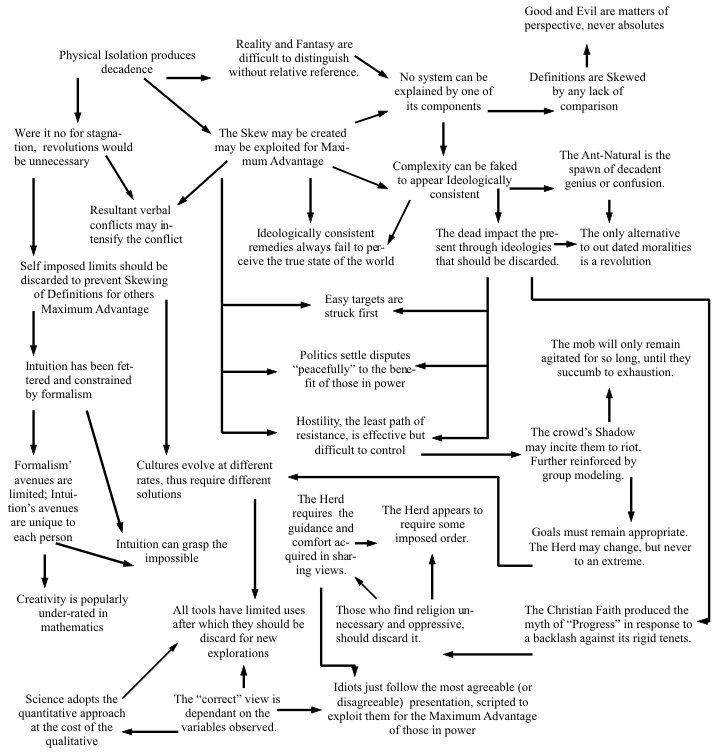
Cultural and social decay is evidenced by decadence. Its advanced stages will lead to nihilism. Many have already chosen escape and isolation through chemical and/or electronic stimulation.[3] Both have become readily available. Criminalization is merely a tool for sometimes opposite ends. Somebody profits from the tragedy. Delusion finds a ready supply and demand. Illusion fills the shelves. This situation could be considered the physical manifestation of entropy for this system. Progress is merely the mask. Artificial stimulation has slacked restlessness, without supplying a natural solution. Entertainment is the true opiate of the masses. The power supply must not be interrupted. The corporate media has painted a dangerous picture by exaggerating danger. Crime sells. Inane politicians are amusing and make the citizen feel better by lampooning his supposed betters. The ever-increasing power of the real criminals goes unnoticed, except in the financial section. The populace is pliant and passive. Consumerism has created commodities from rebellion and the officially sponsored popular youth culture. Is the selling of the blood soaked Berlin Wall any different than its construction? Servility is maintained. Poor but loyal. Religions cannot fight the trend once their institutions have become a part of the system. Hence, Christians are good; Muslims are bad. Economics has an effect unseen by Marx and Engles, but not by Demming... The old institutions deserve death.
Arms will not combat the machine. Skill and knowledge will be the weapons of the future. The clever will not let more physical abilities deteriorate. Balance is the key. The spins may be reversed by the same methods. Their wholesale denouncement might shed uncomfortable light, and will be avoided by the propagandist. Ever decreasing spans present a marvelous opportunity. Simply space the campaigns, until its validity is unquestioned even by opponents. Propaganda affects everybody including its makers. Conspiracy creates the illusion of greater power. Official norms can prove a boon, rather than a ban to the individual. Weakness sought can be made strength. The wolf among the flock is an apt analogy.
Death to the stupid!
[3] Why is only one considered a drug?
Thursday, June 30, 2005


Wednesday, June 29, 2005
Neither the Government nor the Population (6th Draft): FACTORS Part 3.1.2
i. On Bastard Capitalism:
The phrase, "Life, Liberty and the Pursuit of Property," was first stated by Lohn Locke, describing the fundamental rights of man. These words espouse the meaning of capitalism, which no longer exists. Thomas Jefferson later replaced the ending with the less specific and esoteric "happiness." It seemed slave owners felt the common man did not too much encouragement. While the lower classes sought a myth, the monied elite never forgot Locke's words, if not the spirit regarding competition. Hence, we observe the idle corpulent hoarding wealth. The circulation of funds has been impeded to the point where debt becomes necessary for maintaining the status quo. Debt is really the Achilles' Heel for the rich. Artificial control and stimulation measures will only prolong the situation. Its alleviation is often attempted where the varied systemic mechanisms are not even understood by the managers. Corporate state socialism will eventually bankrupt the masses. Massive instability will occur once a statistically significant world figure experiences default. The wealthy underwriters will be ruined. Currency devaluation can occur by seriously damaging clout. Stateless capital funds would collapse, being based upon even less. The power structure will face a crisis when its revenue base disappears. The global economic system will collapse, causing international strife. Civil order could be thrown into chaos. The population will have grown soft and unable to survive otherwise. Ugly exchanges would be probable. The power vacuum must be filled.
Only the time frame is indeterminate, occurring between 10 and 110 years. The longer duration will ensure the greatest disturbance due to full integration levels. True anarchy might last a few hours. Power will be seized and maintained during this period. Justice will be redefined. No benevolent pretenses will exist or be honored. Rights are a luxury. The power elite's death spasms will trap or ensnare many. Care must be taken to avoid that fate, although it certainly applies to enemies. Revenge will follow. The system will have fallen by its own accounting. The tab must be paid.
The phrase, "Life, Liberty and the Pursuit of Property," was first stated by Lohn Locke, describing the fundamental rights of man. These words espouse the meaning of capitalism, which no longer exists. Thomas Jefferson later replaced the ending with the less specific and esoteric "happiness." It seemed slave owners felt the common man did not too much encouragement. While the lower classes sought a myth, the monied elite never forgot Locke's words, if not the spirit regarding competition. Hence, we observe the idle corpulent hoarding wealth. The circulation of funds has been impeded to the point where debt becomes necessary for maintaining the status quo. Debt is really the Achilles' Heel for the rich. Artificial control and stimulation measures will only prolong the situation. Its alleviation is often attempted where the varied systemic mechanisms are not even understood by the managers. Corporate state socialism will eventually bankrupt the masses. Massive instability will occur once a statistically significant world figure experiences default. The wealthy underwriters will be ruined. Currency devaluation can occur by seriously damaging clout. Stateless capital funds would collapse, being based upon even less. The power structure will face a crisis when its revenue base disappears. The global economic system will collapse, causing international strife. Civil order could be thrown into chaos. The population will have grown soft and unable to survive otherwise. Ugly exchanges would be probable. The power vacuum must be filled.
Only the time frame is indeterminate, occurring between 10 and 110 years. The longer duration will ensure the greatest disturbance due to full integration levels. True anarchy might last a few hours. Power will be seized and maintained during this period. Justice will be redefined. No benevolent pretenses will exist or be honored. Rights are a luxury. The power elite's death spasms will trap or ensnare many. Care must be taken to avoid that fate, although it certainly applies to enemies. Revenge will follow. The system will have fallen by its own accounting. The tab must be paid.
Tuesday, June 28, 2005
Neither the Government nor the Population (6th Draft): FACTORS Part 3.1.1
Chapter 3
Factors
Part 3.1.1
1. On the Demise (Contributions):
Many signs are apparent regarding the eventual destruction of the old guard. The Power Fabric is unravelling, attributable to a host of factors. The whole is different than the sum of its parts. The entire social strata is suffering from decadence and even nihilism. It would seem isolation has it price. Generational expectations have declined. The pie has many more mouths to feed. The fastest growing sectors of a booming economy creates only low wage service jobs or information related sedentary employment. Lard is slow. Neither adequately replaces industry. The forced hopes and dreams once sustaining the population are evaporating for many. Even the educated elite are not immune. Their disenfranchisement has historically marked turning points for widespread revolts. Ellul has demonstrated the susceptibility of Intellectuals to propaganda.[1] Hence, their interests and pursuits are directed toward the out dated, trivial or decadent. Once this situation could have led to widespread revolt or dissent.[2] Now, only vicarious hollow shells remain. Politics offers nothing except for the rich and middle class appeasement. The forced commonality preached by the left, and conservative values parroted by the right are equally nauseating. The lowest common denominator is encouraged by bastard capitalism and socialism. A "free market" offers more meaningless diversions. Unrest is negated, creating stasis. This anti-natural state does not respect entropy. The cost is internal rot.
[1] Essentially, intellectuals are better informed, thereby encountering propaganda more frequently. Their easily battered ego will prevent acknowledgement.
[2] During the 20th century, the disillusioned educated elite has fomented most revolutions and resistance campaigns. A notable exception is the case of Maoist China. The anti-Vietnam War movement was largely instigated by college students. Civil rights were supported widely across many campuses. The Russian, Cuban, and Iranian Revolutions were led by educated people. Most simply could not find jobs.
Factors
Part 3.1.1
1. On the Demise (Contributions):
Many signs are apparent regarding the eventual destruction of the old guard. The Power Fabric is unravelling, attributable to a host of factors. The whole is different than the sum of its parts. The entire social strata is suffering from decadence and even nihilism. It would seem isolation has it price. Generational expectations have declined. The pie has many more mouths to feed. The fastest growing sectors of a booming economy creates only low wage service jobs or information related sedentary employment. Lard is slow. Neither adequately replaces industry. The forced hopes and dreams once sustaining the population are evaporating for many. Even the educated elite are not immune. Their disenfranchisement has historically marked turning points for widespread revolts. Ellul has demonstrated the susceptibility of Intellectuals to propaganda.[1] Hence, their interests and pursuits are directed toward the out dated, trivial or decadent. Once this situation could have led to widespread revolt or dissent.[2] Now, only vicarious hollow shells remain. Politics offers nothing except for the rich and middle class appeasement. The forced commonality preached by the left, and conservative values parroted by the right are equally nauseating. The lowest common denominator is encouraged by bastard capitalism and socialism. A "free market" offers more meaningless diversions. Unrest is negated, creating stasis. This anti-natural state does not respect entropy. The cost is internal rot.
[1] Essentially, intellectuals are better informed, thereby encountering propaganda more frequently. Their easily battered ego will prevent acknowledgement.
[2] During the 20th century, the disillusioned educated elite has fomented most revolutions and resistance campaigns. A notable exception is the case of Maoist China. The anti-Vietnam War movement was largely instigated by college students. Civil rights were supported widely across many campuses. The Russian, Cuban, and Iranian Revolutions were led by educated people. Most simply could not find jobs.
Monday, June 27, 2005
Sunday, June 26, 2005
"Towards a Fresh Revolution" by The Friends of Durruti Group (Towards a Fresh Revolution)
Towards a Fresh Revolution
The demise of the July revolution has been rapid. None of the revolutions generally regarded as the archetypes of social revolution experienced such a giddy decline.
There can be no theorising about events following one another in stages, because revolution is not yet a fact. It is imperative that the inexhaustive genius of proletarian Spain be tapped once again. We must go out and make a new beginning.
Revolutions occur with great frequency in our country. Sometimes they are embarked upon with out the requisite conditions being present and with no possibility of success. One has to be able to divine the precise moment, psychologically and insurrectionally speaking. The outcome hangs on the correct choice.
Making forecasts is no easy task. Who can say when a new July or even a new May may be possible? We may assume, however, that in Spain the conditions will present themselves afresh.
If the war continues to take this unfavourable turn all the politicians looking for a way to arrive at an armistice and a fraternal embrace will have to be cast on to the dung-heap. Good evidence of this is the sabotaging of the war, the war industries and the whole gamut of supplies, as well as the inflated prices of food - an inflation fomented by those in power with an eye to creating a favourable atmosphere in which to execute their plans for strangling the revolution.
It may, perhaps, be that a negotiated settlement becomes a reality. Then the time will have come to resist it by force of arms. And should we win the war those problems that are posed in such poignant form today will be roused again on the return of our comrades from the fronts. What solutions will be found to them?
How will the industry of war be converted into an industry of peace? Will there be work for the fighting men? Will all the victims be looked after? Will the officer class resign itself to the loss of its sinecures? Can markets be won back again?
The three dates we have described each correspond to different positions. We cannot say which will apply. The problem, however, hinges on the preparation of a new rebellion so that the proletariat can assume control of the country in a definite way.
They cannot say we are over-reacting. The present moment has nothing revolutionary about it. The counter-revolution feels quite bold enough to mount all sorts of provocations. The jails are crammed with workers. The rights of the proletariat are openly denied. We revolutionary workers are treated like underlings. The language of the bureaucrats, in uniform and out of uniform, is intolerable. Not to mention the attacks on the unions.
A fresh revolution is the only course of action open. Let us set about its preparation. And at the height of a new stroke, we shall join the comrades who are today away fighting on the fronts, the comrades in the jails and the comrades who, even now, cherish the hope of a revolution that may bring justice to the working class; all in the streets together.
To the success of a fresh revolution that will bring the workers of town and country complete satisfaction. To the attainment of an anarchist society that will satisfy man’s aspirations.
Forward comrades!!
The demise of the July revolution has been rapid. None of the revolutions generally regarded as the archetypes of social revolution experienced such a giddy decline.
There can be no theorising about events following one another in stages, because revolution is not yet a fact. It is imperative that the inexhaustive genius of proletarian Spain be tapped once again. We must go out and make a new beginning.
Revolutions occur with great frequency in our country. Sometimes they are embarked upon with out the requisite conditions being present and with no possibility of success. One has to be able to divine the precise moment, psychologically and insurrectionally speaking. The outcome hangs on the correct choice.
Making forecasts is no easy task. Who can say when a new July or even a new May may be possible? We may assume, however, that in Spain the conditions will present themselves afresh.
If the war continues to take this unfavourable turn all the politicians looking for a way to arrive at an armistice and a fraternal embrace will have to be cast on to the dung-heap. Good evidence of this is the sabotaging of the war, the war industries and the whole gamut of supplies, as well as the inflated prices of food - an inflation fomented by those in power with an eye to creating a favourable atmosphere in which to execute their plans for strangling the revolution.
It may, perhaps, be that a negotiated settlement becomes a reality. Then the time will have come to resist it by force of arms. And should we win the war those problems that are posed in such poignant form today will be roused again on the return of our comrades from the fronts. What solutions will be found to them?
How will the industry of war be converted into an industry of peace? Will there be work for the fighting men? Will all the victims be looked after? Will the officer class resign itself to the loss of its sinecures? Can markets be won back again?
The three dates we have described each correspond to different positions. We cannot say which will apply. The problem, however, hinges on the preparation of a new rebellion so that the proletariat can assume control of the country in a definite way.
They cannot say we are over-reacting. The present moment has nothing revolutionary about it. The counter-revolution feels quite bold enough to mount all sorts of provocations. The jails are crammed with workers. The rights of the proletariat are openly denied. We revolutionary workers are treated like underlings. The language of the bureaucrats, in uniform and out of uniform, is intolerable. Not to mention the attacks on the unions.
A fresh revolution is the only course of action open. Let us set about its preparation. And at the height of a new stroke, we shall join the comrades who are today away fighting on the fronts, the comrades in the jails and the comrades who, even now, cherish the hope of a revolution that may bring justice to the working class; all in the streets together.
To the success of a fresh revolution that will bring the workers of town and country complete satisfaction. To the attainment of an anarchist society that will satisfy man’s aspirations.
Forward comrades!!
Saturday, June 25, 2005
"Towards a Fresh Revolution" by The Friends of Durruti Group (III - Free Municipality)
III - Free Municipality.
Prior to the coming of the foreign dynasties, municipal rights were defended with great tenacity in Spain. Such decentralisation precluded the erection of a new State system. And in this new Spain which the proletariat looks forward to, the charter of freedoms that went under at Villalar shall rise again. And the so-called Catalan and Basque problems... will be resolved.
The Municipality shall take charge of those functions of society that fall outside the preserve of the unions. And since the society we are going to build shall be composed exclusively of producers, it will be the unions, no less, that will provide sustenance for the municipalities. And, as there is no disparity of interests, there can be no conflict.
The Municipalities will be organised at the level of local, comarcal and peninsula federations. Unions and municipalities will maintain liaison at local, comarcal and national levels.
Prior to the coming of the foreign dynasties, municipal rights were defended with great tenacity in Spain. Such decentralisation precluded the erection of a new State system. And in this new Spain which the proletariat looks forward to, the charter of freedoms that went under at Villalar shall rise again. And the so-called Catalan and Basque problems... will be resolved.
The Municipality shall take charge of those functions of society that fall outside the preserve of the unions. And since the society we are going to build shall be composed exclusively of producers, it will be the unions, no less, that will provide sustenance for the municipalities. And, as there is no disparity of interests, there can be no conflict.
The Municipalities will be organised at the level of local, comarcal and peninsula federations. Unions and municipalities will maintain liaison at local, comarcal and national levels.
Friday, June 24, 2005
"Towards a Fresh Revolution" by The Friends of Durruti Group (II - All economic power to the syndicates)
II - All economic power to the syndicates
Since July the unions have supplied evidence of the great capacity for constructive labour. Had we not relegated them to a secondary position, they would have yielded a great return on the investment. It will be the unions that structure the proletarian economy.
An Economic Council may also be set up, taking into consideration the natures of the Industrial Unions and Industrial federations, to improve on the co-ordination of economic activities.
Since July the unions have supplied evidence of the great capacity for constructive labour. Had we not relegated them to a secondary position, they would have yielded a great return on the investment. It will be the unions that structure the proletarian economy.
An Economic Council may also be set up, taking into consideration the natures of the Industrial Unions and Industrial federations, to improve on the co-ordination of economic activities.
Thursday, June 23, 2005
The Modern Warrior Archetype
The Modern Warrior Archetype
On The New Warrior Class From Parameters, Summer 1994, pp. 16-26.
A few observations and excerpts:
1. He's not really a product of the technological society. He's the result of its breakdown. He's also older. However, he's not above employing its tools. Like all other archetypes, he is a product. (Just not entirely of the media.)
2. "For the US soldier, vaccinated with moral and behavioral codes, the warrior is a formidable enemy. Euro-American soldiers in general learn a highly stylized, ritualized form of warfare, with both written and customary rules. We are at our best fighting organized soldieries who attempt a symmetrical response. But warriors respond asymmetrically, leaving us in the role of redcoats marching into an Indian-dominated wilderness." (Italics are mine.)
3. The brutality of Child Soldiers is not touched upon (especially Girls.) You don't need to be an adult to kill.
4. Religious fanatics are not necessarily applicable to this archetype. The Modern Warrior is not suicidal. (Although, he will certainly use those sorts for Maximum Advantage if available.)
On The New Warrior Class From Parameters, Summer 1994, pp. 16-26.
A few observations and excerpts:
1. He's not really a product of the technological society. He's the result of its breakdown. He's also older. However, he's not above employing its tools. Like all other archetypes, he is a product. (Just not entirely of the media.)
2. "For the US soldier, vaccinated with moral and behavioral codes, the warrior is a formidable enemy. Euro-American soldiers in general learn a highly stylized, ritualized form of warfare, with both written and customary rules. We are at our best fighting organized soldieries who attempt a symmetrical response. But warriors respond asymmetrically, leaving us in the role of redcoats marching into an Indian-dominated wilderness." (Italics are mine.)
3. The brutality of Child Soldiers is not touched upon (especially Girls.) You don't need to be an adult to kill.
4. Religious fanatics are not necessarily applicable to this archetype. The Modern Warrior is not suicidal. (Although, he will certainly use those sorts for Maximum Advantage if available.)
Wednesday, June 22, 2005
"Towards a Fresh Revolution" by The Friends of Durruti Group (I - Establishment of a Revolutionary Junta or National Defence Council)
I - Establishment of a Revolutionary Junta or National Defence Council
This body will be organised as follows: members of the revolutionary Junta will be elected by democratic vote in the union organisations. Account is to be taken of the number of comrades away at the front; these comrades must have the right to representation. The Junta will steer clear of economic affairs, which are the exclusive preserve of the unions.
The functions of the revolutionary Junta are as follows:
a) The management of the war
b) The supervision of revolutionary order
c) International affairs
d) Revolutionary propaganda.
Posts to come up regularly for re-allocation so as to prevent anyone growing attached to them. And the trade union assemblies will exercise control over the Junta’s activities.
This body will be organised as follows: members of the revolutionary Junta will be elected by democratic vote in the union organisations. Account is to be taken of the number of comrades away at the front; these comrades must have the right to representation. The Junta will steer clear of economic affairs, which are the exclusive preserve of the unions.
The functions of the revolutionary Junta are as follows:
a) The management of the war
b) The supervision of revolutionary order
c) International affairs
d) Revolutionary propaganda.
Posts to come up regularly for re-allocation so as to prevent anyone growing attached to them. And the trade union assemblies will exercise control over the Junta’s activities.
Tuesday, June 21, 2005
"Towards a Fresh Revolution" by The Friends of Durruti Group (Our Programme)
Our Programme
Revolutions cannot succeed if they have no guiding lights, no immediate objectives. That is what we find lacking in the July revolution. Although it had the strength, the CNT did not know how to mould and shape the activity that arose spontaneously in the street. The very leadership was startled by events which were, as far as they were concerned, totally unexpected.
They had no idea which course of action to pursue. There was no theory. Year after year we had spent speculating around abstractions. What is to be done? The leaders were asking themselves then. And they allowed the revolution to be lost.
Such exalted moments leave no time for hesitancy. Rather, one must know where one is headed. This is precisely the vacuum we seek to fill, since we feel that what happened in July and May must never happen again.
We are introducing a slight variation in anarchism into our programme. The establishment of a revolutionary Junta.
As we see it, the revolution needs organisms to oversee it, and repress, in an organised sense, hostile sectors. As current events have shown such sectors do not accept oblivion unless they are crushed.
There may be anarchist comrades who feel certain ideological misgivings, but the lesson of experience is enough to induce us to stop pussyfooting.
Unless we want a repetition of what is happening with the present revolution, we must proceed with the utmost energy against those who are not identified with the working class.
After this brief preamble, we shall now proceed to set out the items of our programme.
Revolutions cannot succeed if they have no guiding lights, no immediate objectives. That is what we find lacking in the July revolution. Although it had the strength, the CNT did not know how to mould and shape the activity that arose spontaneously in the street. The very leadership was startled by events which were, as far as they were concerned, totally unexpected.
They had no idea which course of action to pursue. There was no theory. Year after year we had spent speculating around abstractions. What is to be done? The leaders were asking themselves then. And they allowed the revolution to be lost.
Such exalted moments leave no time for hesitancy. Rather, one must know where one is headed. This is precisely the vacuum we seek to fill, since we feel that what happened in July and May must never happen again.
We are introducing a slight variation in anarchism into our programme. The establishment of a revolutionary Junta.
As we see it, the revolution needs organisms to oversee it, and repress, in an organised sense, hostile sectors. As current events have shown such sectors do not accept oblivion unless they are crushed.
There may be anarchist comrades who feel certain ideological misgivings, but the lesson of experience is enough to induce us to stop pussyfooting.
Unless we want a repetition of what is happening with the present revolution, we must proceed with the utmost energy against those who are not identified with the working class.
After this brief preamble, we shall now proceed to set out the items of our programme.
Monday, June 20, 2005
"Towards a Fresh Revolution" by The Friends of Durruti Group (Our Position)
Our Position
It is time to be specific. We shall be so, with respect to each of the problems posed by the present situation.
With regard to the problem of the war, we back the idea of the army being under the absolute control of the working class. Officers with their origins in the capitalist regime do not deserve the slightest trust from us. Desertions have been numerous and most of the disasters we have encountered can be laid down to obvious betrayals by officers. As to the army, we want a revolutionary one led exclusively by workers, and, should any officer be retained, it must be under the strictest supervision.
We insist that the war be directed by the workers. We have grounds aplenty for this. The defeats at Toledo, Talavera, the loss of the North and Malaga point to incompetence and lack of integrity in the government circles, for the following reasons:
The North of Spain could have been saved if the war materials needed for resistance to the enemy had been obtained. The means were there. The Bank of Spain had enough gold to flood Spanish soil with weaponry. Why was it not done? There was time. We must remember that the non-intervention controls did not begin to make their presence felt until the war in Spain was already some months old.
Leadership in the conduct of the war has been disastrous. Largo Caballero’s record is lamentable. That the Aragon Front has not been given the arms its so needs is his fault. His reluctance to arm the Aragonese sector has prevented Aragon from assuring her own redemption from the clutches of the fascists. At the same time this could have taken the pressure off the fronts around Madrid and the North. And it was Largo Caballero who expressed the sentiment that sending arms to the Aragon Front was like handing them over to the CNT.
***************
We are opposed to collaboration with bourgeois groups. We do not believe that the class approach can be abandoned.
Revolutionary workers must not shoulder official posts, nor establish themselves in the ministries. For as long as the war lasts, collaboration is permissible - on the battlefield, in the trenches, on the parapets and in productive labour in the rearguard.
Our place is in the unions, in the work place, keeping alive that spirit of rebellion which will bloom on the earliest occasion that presents itself.
We must have no part of combinations devised by bourgeois politicians acting in concert with foreign chancelleries. That would be tantamount to strengthening our enemies and tightening the noose of capitalism. No more portfolios. No more ministries. Let’s get back to the unions and the nitty-gritty of work tools.
********************
Let us campaign for unity among the proletariat. But on the understanding that this unity must be between workers, and not with bureaucrats or sinecurists.
At present, an agreement with the revolutionary wing of the UGT by the CNT is a feasible prospect. But we do not believe that an understanding is possible with the UGT of Catalonia, or with Prieto’s followers.
************************
Socialisation of the economy is crucial to victory in the war and progress in the revolution. The present drift cannot continue. Nor should anyone believe there is any advantage in the various centres of production operating to no co-ordinated pattern.
But it has to be the workers who see that this is done.
***********************
Nor should the business about religion come up for further discussion. The people have already delivered its final verdict on that issue. Nonetheless, a tendency aimed at re-opening the churches, has emerged. Implementation of the law of freedom of worship and celebration of masses lead us to the conclusion that those in Government have forgotten the days of the great burnings.
***************************
There must be strict rationing in the distribution of goods. That workers should go hungry while hoarders find food in restaurants controlled by the working class is intolerable.
Distribution must be socialised and accompanied by rationing.
Bureaucracy must go. The thousands of bureaucrats who have descended on Barcelona are one of the worst plagues ever visited on us. In place of a bureaucrat, there ought to be a worker. And by bureaucrat we mean any cafe layabout.
*************************
Absolute suppression of the bureaucracy.
*************************
Fabulous rates of pay must go immediately. It is scandalous that where militiamen are earning ten pesetas a day, the bureaucrats are taking home such huge wages. Azana and Companys are still drawing the same salary as before.
We want to see the introduction of the family wage. And an end, once and for all, to this galling inequality.
It must be the people who administer justice. We cannot countenance the false practice that has grown up in this regard. There has been a drift away from the early class tribunals to courts made up of career magistrates. And we are going back to the way things used to be. Now they are doing away with the juries.
Proletarian justice belongs to the workers alone.
************************
There must be progress towards socialisation of the farming industry in Spain. The sabotaging of the collectives has harmed agriculture enormously and has favoured speculation. Contact between town and countryside will bring the peasants closer to the proletarian class. And the mentality of the farm worker used to tilling his own particular plot will be changed.
***********************
Like any other activity in the country that falls under the headings social, cultural or economic, cultural problems are the indisputable province of the workers. It was they who set the pattern of this new era.
************************
Revolutionary order will be enforced by the workers. We insist that the uniformed corps, which are no guarantee of revolution, be dissolved. The unions must supply the men whose task it is to guard the new order we wish to implant.
**********************
As to foreign policy, we shall accept no armistice; and, when it comes to propagandising our revolution, we are of the view that that work must be done among the production centres abroad; not in any chancelleries, let alone any cabals.
We must speak to the workers abroad in the language of revolution. So far the vocabulary of democracy has been employed. It has to be brought home to the workers’ organisations, to everyone, that they must act: to sabotage fascist production: to refuse to load raw materials or war materials for the assassins of the Spanish people. And that they must demonstrate in the streets, to demand fair treatment by their governments for the cause we defend, which is the cause of the world’s proletariat.
It is time to be specific. We shall be so, with respect to each of the problems posed by the present situation.
With regard to the problem of the war, we back the idea of the army being under the absolute control of the working class. Officers with their origins in the capitalist regime do not deserve the slightest trust from us. Desertions have been numerous and most of the disasters we have encountered can be laid down to obvious betrayals by officers. As to the army, we want a revolutionary one led exclusively by workers, and, should any officer be retained, it must be under the strictest supervision.
We insist that the war be directed by the workers. We have grounds aplenty for this. The defeats at Toledo, Talavera, the loss of the North and Malaga point to incompetence and lack of integrity in the government circles, for the following reasons:
The North of Spain could have been saved if the war materials needed for resistance to the enemy had been obtained. The means were there. The Bank of Spain had enough gold to flood Spanish soil with weaponry. Why was it not done? There was time. We must remember that the non-intervention controls did not begin to make their presence felt until the war in Spain was already some months old.
Leadership in the conduct of the war has been disastrous. Largo Caballero’s record is lamentable. That the Aragon Front has not been given the arms its so needs is his fault. His reluctance to arm the Aragonese sector has prevented Aragon from assuring her own redemption from the clutches of the fascists. At the same time this could have taken the pressure off the fronts around Madrid and the North. And it was Largo Caballero who expressed the sentiment that sending arms to the Aragon Front was like handing them over to the CNT.
***************
We are opposed to collaboration with bourgeois groups. We do not believe that the class approach can be abandoned.
Revolutionary workers must not shoulder official posts, nor establish themselves in the ministries. For as long as the war lasts, collaboration is permissible - on the battlefield, in the trenches, on the parapets and in productive labour in the rearguard.
Our place is in the unions, in the work place, keeping alive that spirit of rebellion which will bloom on the earliest occasion that presents itself.
We must have no part of combinations devised by bourgeois politicians acting in concert with foreign chancelleries. That would be tantamount to strengthening our enemies and tightening the noose of capitalism. No more portfolios. No more ministries. Let’s get back to the unions and the nitty-gritty of work tools.
********************
Let us campaign for unity among the proletariat. But on the understanding that this unity must be between workers, and not with bureaucrats or sinecurists.
At present, an agreement with the revolutionary wing of the UGT by the CNT is a feasible prospect. But we do not believe that an understanding is possible with the UGT of Catalonia, or with Prieto’s followers.
************************
Socialisation of the economy is crucial to victory in the war and progress in the revolution. The present drift cannot continue. Nor should anyone believe there is any advantage in the various centres of production operating to no co-ordinated pattern.
But it has to be the workers who see that this is done.
***********************
Nor should the business about religion come up for further discussion. The people have already delivered its final verdict on that issue. Nonetheless, a tendency aimed at re-opening the churches, has emerged. Implementation of the law of freedom of worship and celebration of masses lead us to the conclusion that those in Government have forgotten the days of the great burnings.
***************************
There must be strict rationing in the distribution of goods. That workers should go hungry while hoarders find food in restaurants controlled by the working class is intolerable.
Distribution must be socialised and accompanied by rationing.
Bureaucracy must go. The thousands of bureaucrats who have descended on Barcelona are one of the worst plagues ever visited on us. In place of a bureaucrat, there ought to be a worker. And by bureaucrat we mean any cafe layabout.
*************************
Absolute suppression of the bureaucracy.
*************************
Fabulous rates of pay must go immediately. It is scandalous that where militiamen are earning ten pesetas a day, the bureaucrats are taking home such huge wages. Azana and Companys are still drawing the same salary as before.
We want to see the introduction of the family wage. And an end, once and for all, to this galling inequality.
It must be the people who administer justice. We cannot countenance the false practice that has grown up in this regard. There has been a drift away from the early class tribunals to courts made up of career magistrates. And we are going back to the way things used to be. Now they are doing away with the juries.
Proletarian justice belongs to the workers alone.
************************
There must be progress towards socialisation of the farming industry in Spain. The sabotaging of the collectives has harmed agriculture enormously and has favoured speculation. Contact between town and countryside will bring the peasants closer to the proletarian class. And the mentality of the farm worker used to tilling his own particular plot will be changed.
***********************
Like any other activity in the country that falls under the headings social, cultural or economic, cultural problems are the indisputable province of the workers. It was they who set the pattern of this new era.
************************
Revolutionary order will be enforced by the workers. We insist that the uniformed corps, which are no guarantee of revolution, be dissolved. The unions must supply the men whose task it is to guard the new order we wish to implant.
**********************
As to foreign policy, we shall accept no armistice; and, when it comes to propagandising our revolution, we are of the view that that work must be done among the production centres abroad; not in any chancelleries, let alone any cabals.
We must speak to the workers abroad in the language of revolution. So far the vocabulary of democracy has been employed. It has to be brought home to the workers’ organisations, to everyone, that they must act: to sabotage fascist production: to refuse to load raw materials or war materials for the assassins of the Spanish people. And that they must demonstrate in the streets, to demand fair treatment by their governments for the cause we defend, which is the cause of the world’s proletariat.
Sunday, June 19, 2005
"Towards a Fresh Revolution" by The Friends of Durruti Group (Collaboration and Class Struggle)
Collaboration and Class Struggle
In Spain, as has generally been the case in every country, the workers’ movement has shown two tendencies. One, the collaborationist one, and the other that admits no truck whatsoever with the enemy.
In this country of ours, it has been socialism with its trade-union offshoot, the UGT that has played the classic role of reformists. It is a refuge for renegade workers, even of infiltrators into workers’ organisations whose sole purpose is to yoke the proletariat to the cart of the bourgeoisie.
The statements made by Indalecio Prieta during the Red biennium, on the occasion of the railway mens’ strike, encapsulate the essence of collaboration ism. They are notorious.
“I am a minister first, and then a socialist” don Inda stated then.
The Spanish revolution has suffered because of the reformists’ pernicious influence on its direction. There has been no willingness to interpret the social, class meaning of the July happenings.
The class struggle that the CNT has always preached has been relegated to a secondary position by a series of issues that have proved enormously prejudicial to the course of the revolutions. Noting this relegation we must not only deplore this disfiguration of the revolution, but also in organic terms the ground lost through the failure to keep strictly to line of revolution on a class terrain and through having trampled Revolutionary Syndicalism into the ground.
The unions are the organs that genuinely articulate the workers’ class feeling in their eternal battle with capitalism. If we relegate the unions to a secondary position, it follows naturally that the interests of the proletariat will be prejudiced.
Collaborationism is to be deplored at all times. There must be no collaboration with capitalism whether outside the bourgeois state or from within the government itself. As producers our place is in the unions, reinforcing the only bodies that ought to survive a revolution headed by the workers.
Class struggle is no obstacle to workers continuing at present to fight on in the battlefields and working in the war industries. But it is imperative to keep it in mind that we proceed to each new initiative with a class sense, giving the unions the priority that is their due.
There must be no other economic body outside the unions to restrict their powers. And the State cannot be retained in the face of the unions - let alone bolstered up by our own forces. The fight against capitalism goes on. Inside our own territory there is still a bourgeoisie connected with the international bourgeoisie. The problem is now what it has been for years.
Let us keep the unions true to themselves. Let us keep to the line mapped out by the CNT in its particular confrontation with our native bourgeoisie, as was always the norm up to 19 July.
Collaborationists are allies of the bourgeoisie. Individuals who advocate such relations have no feeling for the class struggle, nor have they the slightest regard for the unions.
Never must we accept the consolidation of our enemy’s positions.
The enemy must be restricted. If ever faced with a hiatus we must never allow that social deviation to develop into a position of open assistance to capital.
There can be absolutely no common ground between exploiters and exploited. Which shall prevail, only battle can decide. Bourgeoisie or workers. Certainly not both of them at once.
The working class holds the future in its hands. We pariahs have nothing to lose and, on the contrary, we can win our emancipation which is the destiny of the family of workers.
Let us break the shackles. Let us strengthen our unions. Let us keep the spirit of class struggle alive.
In Spain, as has generally been the case in every country, the workers’ movement has shown two tendencies. One, the collaborationist one, and the other that admits no truck whatsoever with the enemy.
In this country of ours, it has been socialism with its trade-union offshoot, the UGT that has played the classic role of reformists. It is a refuge for renegade workers, even of infiltrators into workers’ organisations whose sole purpose is to yoke the proletariat to the cart of the bourgeoisie.
The statements made by Indalecio Prieta during the Red biennium, on the occasion of the railway mens’ strike, encapsulate the essence of collaboration ism. They are notorious.
“I am a minister first, and then a socialist” don Inda stated then.
The Spanish revolution has suffered because of the reformists’ pernicious influence on its direction. There has been no willingness to interpret the social, class meaning of the July happenings.
The class struggle that the CNT has always preached has been relegated to a secondary position by a series of issues that have proved enormously prejudicial to the course of the revolutions. Noting this relegation we must not only deplore this disfiguration of the revolution, but also in organic terms the ground lost through the failure to keep strictly to line of revolution on a class terrain and through having trampled Revolutionary Syndicalism into the ground.
The unions are the organs that genuinely articulate the workers’ class feeling in their eternal battle with capitalism. If we relegate the unions to a secondary position, it follows naturally that the interests of the proletariat will be prejudiced.
Collaborationism is to be deplored at all times. There must be no collaboration with capitalism whether outside the bourgeois state or from within the government itself. As producers our place is in the unions, reinforcing the only bodies that ought to survive a revolution headed by the workers.
Class struggle is no obstacle to workers continuing at present to fight on in the battlefields and working in the war industries. But it is imperative to keep it in mind that we proceed to each new initiative with a class sense, giving the unions the priority that is their due.
There must be no other economic body outside the unions to restrict their powers. And the State cannot be retained in the face of the unions - let alone bolstered up by our own forces. The fight against capitalism goes on. Inside our own territory there is still a bourgeoisie connected with the international bourgeoisie. The problem is now what it has been for years.
Let us keep the unions true to themselves. Let us keep to the line mapped out by the CNT in its particular confrontation with our native bourgeoisie, as was always the norm up to 19 July.
Collaborationists are allies of the bourgeoisie. Individuals who advocate such relations have no feeling for the class struggle, nor have they the slightest regard for the unions.
Never must we accept the consolidation of our enemy’s positions.
The enemy must be restricted. If ever faced with a hiatus we must never allow that social deviation to develop into a position of open assistance to capital.
There can be absolutely no common ground between exploiters and exploited. Which shall prevail, only battle can decide. Bourgeoisie or workers. Certainly not both of them at once.
The working class holds the future in its hands. We pariahs have nothing to lose and, on the contrary, we can win our emancipation which is the destiny of the family of workers.
Let us break the shackles. Let us strengthen our unions. Let us keep the spirit of class struggle alive.
Friday, June 17, 2005
Conflicting Spectra? & On Randomness: A Circular Argument
Thursday, June 16, 2005
"Towards a Fresh Revolution" by The Friends of Durruti Group (Spain’s Independence)
Spain’s Independence
Intervention by foreign powers in the Spanish scene has brought into focus the eternal dilemma in which our country has always found itself.
Since the XVIth century Spain’s political life has been a lien of foreign powers. Two dynasties - one Austrian the other Bourbon, not to mention the short reign of Amadeo of Savoy - kept the people of Spain in subjection up to April 14, 1931.
Spain’s independence has always been a fiction. The Foreign Office and the Quai d’Orsay have played a most important role in our decisions. Remember the pardoning of Sanjurjo after his rebellion in August 1932, granted only after pressure from the French government?
The Spanish economy, a pre-eminently agrarian one, has kept us tied to the apron strings of the big industrial powers. In order to export our produce we have been obliged to buy machinery we could have made at home. And in return for London taking our oranges, we are urged to buy English coal, with the inevitable result that the working day in our coalmines is reduced because of the slump in production at home.
We export iron, copper and other minerals in order to buy the finished machinery, built by the very country that bought its raw materials from us.
Our sub-soil is extremely rich, but foreign capital owns it. Our country is gripped by the tentacles of international finance which devours the people’s wealth. Spanish workers have always sweated in order to satisfy the dividends and substantial profits of foreign stockholders and financiers.
From the dawn of our history, a spirit of independence has been evident in Spaniards. Invasions have been numerous, but they never managed to extinguish the sacred flame of independence.
When we come to the current invasion, it is clearly of a nature that contrasts with the earlier ones in that in the case of the Iberians, Phoenicians, Carthaginians, Romans, Arabs or French, there was no social dimension.
During the Napoleonic invasion, liberals and absolutists stood shoulder to shoulder in the fray. El Empecinado found Father Merino at his side, though only through force of circumstance.
During the expedition of the Duke of Angouleme, authorised by the Holy Alliance from Vienna, opinion in the Peninsula was noticeably divided. Father Merino sided with the invaders. El Empecinado, for his part, resisted the entry of the foreign forces.
What is happening today is a re-enactment of what happened in the reign of Ferdinand VII. Once again in Vienna there has been a conference of fascist dictators for the purpose of organising their invasion of Spain. And the workers in arms have taken up the mantle of El Empecinado.
Germany and Italy need raw materials. They need iron, copper, lead and mercury. But these Spanish mineral deposits are the preserve of France and England. Yet even though Spain faces subjection, England does not protest. On the contrary - in a vile manoeuvre, she tries to negotiate with Franco.
Since the war began, she has helped blockade ports held by us. Fascist shipping unloads war materials at fascist-controlled ports... and take on ore, livestock oil.… International fascism needs food for its machine. Hitler’s slogan - more guns, less butlers - and Mussolini’s autarchy lead them to sack the agricultural regions under the iron-rule of the rebel generals.
In economic matters, we have always been dependent on other countries. Commercial treaties and the balance of payments have never operated in our favour. This trend has been a nightmare for our economy.
Spain’s problem is a colonial one. Capitalism, having extinguished feudalism in its own territory, finds itself in the incongruous position of having to bolster feudal regimes in the countries it seeks to exploit. This goes for Spain as it does likewise for China.
It is up to the working class to ensure Spain’s independence. Native capitalism will not do it, since international capital crosses all frontiers. This is Spain’s current predicament. It is up to us workers to root out the foreign capitalists. Patriotism does not enter into it. It is a matter of class interests.
As the international intrigues go on, it is safe to assume that England will manage to settle the Spanish question on the basis of an ignominious status quo. Will she make economic concessions to Germany and Italy? Will partial rights to our sub-soil resources be hived off to foreign powers? Will Spain be partitioned?
England is interested in our mineral wealth. Such is the colossal pressure of a fascism spread throughout the world and party to the famous Anti-Comintern Pact, that, at best, perfidious Albion will yield; always provided that there is no threat to the free passage of her shipping through the Mare Nostrum.
It is hard to guess what will happen. We must put no trust in the League of Nations, nor in the host of committees and sub-committees, nor in Conferences whose only purpose, like the Nyon Conference, is to waste time on the matter. But it is worth noting that the English Conservatives have recalled Lord Halifax, the author of the massacres in India.
There can be only one question for us; will France be ready to place in the balance not only her maritime, but also her territorial security? Will France keep to the non-intervention policy hammered out by Leon Blum? Is she prepared to renounce her colonial army?
Let us trust no one. Salvation lies in our own hands. Foreign powers incline to the lesser evil, to the cabal. And the working class will find a way to prevent Spain being made subject to an international arrangement, like Tangiers, Danzig or the Saar.
Victory or death, comrades. That is the choice at the present moment.
Intervention by foreign powers in the Spanish scene has brought into focus the eternal dilemma in which our country has always found itself.
Since the XVIth century Spain’s political life has been a lien of foreign powers. Two dynasties - one Austrian the other Bourbon, not to mention the short reign of Amadeo of Savoy - kept the people of Spain in subjection up to April 14, 1931.
Spain’s independence has always been a fiction. The Foreign Office and the Quai d’Orsay have played a most important role in our decisions. Remember the pardoning of Sanjurjo after his rebellion in August 1932, granted only after pressure from the French government?
The Spanish economy, a pre-eminently agrarian one, has kept us tied to the apron strings of the big industrial powers. In order to export our produce we have been obliged to buy machinery we could have made at home. And in return for London taking our oranges, we are urged to buy English coal, with the inevitable result that the working day in our coalmines is reduced because of the slump in production at home.
We export iron, copper and other minerals in order to buy the finished machinery, built by the very country that bought its raw materials from us.
Our sub-soil is extremely rich, but foreign capital owns it. Our country is gripped by the tentacles of international finance which devours the people’s wealth. Spanish workers have always sweated in order to satisfy the dividends and substantial profits of foreign stockholders and financiers.
From the dawn of our history, a spirit of independence has been evident in Spaniards. Invasions have been numerous, but they never managed to extinguish the sacred flame of independence.
When we come to the current invasion, it is clearly of a nature that contrasts with the earlier ones in that in the case of the Iberians, Phoenicians, Carthaginians, Romans, Arabs or French, there was no social dimension.
During the Napoleonic invasion, liberals and absolutists stood shoulder to shoulder in the fray. El Empecinado found Father Merino at his side, though only through force of circumstance.
During the expedition of the Duke of Angouleme, authorised by the Holy Alliance from Vienna, opinion in the Peninsula was noticeably divided. Father Merino sided with the invaders. El Empecinado, for his part, resisted the entry of the foreign forces.
What is happening today is a re-enactment of what happened in the reign of Ferdinand VII. Once again in Vienna there has been a conference of fascist dictators for the purpose of organising their invasion of Spain. And the workers in arms have taken up the mantle of El Empecinado.
Germany and Italy need raw materials. They need iron, copper, lead and mercury. But these Spanish mineral deposits are the preserve of France and England. Yet even though Spain faces subjection, England does not protest. On the contrary - in a vile manoeuvre, she tries to negotiate with Franco.
Since the war began, she has helped blockade ports held by us. Fascist shipping unloads war materials at fascist-controlled ports... and take on ore, livestock oil.… International fascism needs food for its machine. Hitler’s slogan - more guns, less butlers - and Mussolini’s autarchy lead them to sack the agricultural regions under the iron-rule of the rebel generals.
In economic matters, we have always been dependent on other countries. Commercial treaties and the balance of payments have never operated in our favour. This trend has been a nightmare for our economy.
Spain’s problem is a colonial one. Capitalism, having extinguished feudalism in its own territory, finds itself in the incongruous position of having to bolster feudal regimes in the countries it seeks to exploit. This goes for Spain as it does likewise for China.
It is up to the working class to ensure Spain’s independence. Native capitalism will not do it, since international capital crosses all frontiers. This is Spain’s current predicament. It is up to us workers to root out the foreign capitalists. Patriotism does not enter into it. It is a matter of class interests.
As the international intrigues go on, it is safe to assume that England will manage to settle the Spanish question on the basis of an ignominious status quo. Will she make economic concessions to Germany and Italy? Will partial rights to our sub-soil resources be hived off to foreign powers? Will Spain be partitioned?
England is interested in our mineral wealth. Such is the colossal pressure of a fascism spread throughout the world and party to the famous Anti-Comintern Pact, that, at best, perfidious Albion will yield; always provided that there is no threat to the free passage of her shipping through the Mare Nostrum.
It is hard to guess what will happen. We must put no trust in the League of Nations, nor in the host of committees and sub-committees, nor in Conferences whose only purpose, like the Nyon Conference, is to waste time on the matter. But it is worth noting that the English Conservatives have recalled Lord Halifax, the author of the massacres in India.
There can be only one question for us; will France be ready to place in the balance not only her maritime, but also her territorial security? Will France keep to the non-intervention policy hammered out by Leon Blum? Is she prepared to renounce her colonial army?
Let us trust no one. Salvation lies in our own hands. Foreign powers incline to the lesser evil, to the cabal. And the working class will find a way to prevent Spain being made subject to an international arrangement, like Tangiers, Danzig or the Saar.
Victory or death, comrades. That is the choice at the present moment.
Tuesday, June 14, 2005
"Towards a Fresh Revolution" by The Friends of Durruti Group (May 3)
May 3
It has been inside the barracks of Catalonia that counter-revolution has made its greatest efforts to crush the essentials of the July revolution.
The economic structure of Catalonia allowed for great masses of workers, educated to class-consciousness in the atmosphere of factory and workshop, to be concentrated. This peculiar feature of the centres of manufacture is extremely favourable to the attainment of the end of the revolution. In July, Catalonia’s working people placed social life on a fresh basis. There was a resurgence by an indomitable proletariat with the critical equipment of long years of struggle within the ranks of the confederation. Social revolution could have been a fact in Catalonia. Further more, this revolutionary proletariat could have served as a counter-weight to a bureaucratic, reformist Madrid and the influence of the Catholic Basque country.
But the events took a different turn. The revolution was not made in Catalonia. Realising that once again the proletariat was saddled with a leadership of quibblers, the petit bourgeoisie, which had gone into hiding in its backrooms in July, hastened to join battle.
The shocking feature of when we speak of the middle class is that we have to refer to Marxists, who have been inundated by shopkeepers and the Lliga’s 120,000 voters.
In Catalonia, socialism has been a pitiful creature. Its ranks have been swelled by members opposed to revolution. It has captained the counter-revolution. It has spawned a UGT which has been turned into an appendage of the GEPCI. Marxist leaders have sung the praises of counter-revolution. They have sculpted slogans about the issue of a united front whilst first eliminating the POUM, then trying to repeat the operation with the CNT.
The manoeuvres of the petite bourgeoisie, in alliance with the socialists and communists, culminated in the events of May.
There have been conflicting versions of just what happened in May. But the truth of the matter is that the counter-revolution wanted the working class on the streets in a disorganised manner so that they might be crushed. They partially attained their objectives, thanks to the stupidity of some leaders who gave the ceasefire order and dubbed the ‘Friends of Durruti’ agents provocateurs just when the streets had been won and the enemy eliminated.
Self-evidently, the counter-revolution has an interest in control of Public Order passing under the supervision of the Valencia Government. They succeeded in that, thanks to Largo Caballero. It is worth noting that at this time the CNT had four ministers in the cabinet.
It has also been pointed out that the petit bourgeoisie had hatched a scheme providing for foreign intervention on the pretext of disorder breaking out. That foreign flotilla would sail for Barcelona was a certainty. And there has been talk of motorised divisions of the French army on the verge of intervening in frontier posts. To which we might add the conspiratorial work of politicians meeting in the French capital.
The atmosphere had become very tense. CNT membership cards were being torn up. CNT and FAI militants were being disarmed. There were continuous clashes which only by the merest chance did not turn out to have more serious consequences. The provocations that we workers had to put up with were manifold. The threats from the desk-ocracy came out into the open, naked and unashamed.
The death of a socialist militant - Roldan - was exploited as the pretext for a monster display of strength in which all the counter-revolutionary crew took part.
Everything that went wrong was blamed on the CNT. Anarchists were blamed for every misfortune. Food shortages were laid at the door of the supply committees.
The explosion came on the 3rd May. With the cognisance of Ayguade, Rodriguez Salas, Commissar for Public Order, headed a unit of Assault Guards and burst into the Telephone Exchange. They tried to disarm the CNT comrades, even though the Exchange was under joint control of the CNT and UGT.
This move by Rodriguez Salas - who belongs to the PSUC - was a call to arms. Within a few hours barricades had gone up in all the streets in Barcelona city. The crackle of rifle-fire and the rattle of machine guns could be heard and the air was filled with the sounds of cannon salvoes and the reports of bombs.
At the end of a few hours, the tide had turned in the favour of the proletarians enrolled in the CNT who as they had in July, defended their rights with guns in hand. We took the streets. They were ours. There was no power on earth that could have wrested them from us. Working class areas fell to us quickly. Then the enemy’s territory was eaten away, little by little, to a redoubt in a section of the residential area - the city centre - which would have fallen soon, but for the defection of the CNT committees.
Realising the indecision that showed itself in the fighting, and the lack of leadership and organisation evident in the street, our Grouping issued a leaflet followed by a manifesto.
They labelled us agents provocateurs because we demanded that provocateurs be shot, that the armed forces be disbanded, that political parties who had armed the provocation be suppressed, and also that a revolutionary Junta be established, to press on with the socialisation of the economy and to claim all economic power for the unions.
Our analysis, as set out in those moments of tension in both leaflet and manifesto, insisted that the barricades should not be abandoned unconditionally, since that would be the first time in history when a victorious army had yielded ground to the enemy.
Guarantees were needed that we would not be persecuted. But the chieftains of the CNT gave assurances that the organisation’s representatives in the Generalitat would look out for the working class. Nonetheless, the second part of what had come to pass hours earlier in Valencia emerged.
The barricades were abandoned without our having good reason to do so. As the Catalan scene was returning to calm, the excesses perpetrated by the Marxists and the public forces came to light. We had been right. Comrade Berneri was snatched from his home and shot to death in the middle of the street: thirty comrades were discovered, horribly mutilated in Sardanola; Comrade Martinez of the Libertarian Youth lost his life in a manner unknown, in the private dungeons of the Cheka, and a large number of comrades from the CNT and FAI were brutally murdered.
We must remember that Professor Berneri was a learned Italian comrade from that anti-fascist Italy filling the deportation islands, the cemeteries and the concentration camps. Like his anti-fascist comrades, he could not stay in Mussolini’s Italy.
The murders were followed by a wave of intense repression. Comrades were arrested in connection with the events in July and May: there were attacks on unions, collectives and offices of the Friends of Durruti, the Libertarian Youth and the POUM.
One event we cannot pass over. The disappearance and death of Andres Nin. More than half a year has elapsed now and the Government has yet to clear up the so-called mystery surrounding Nin’s murder. Shall we one day know who killed him?
After May, the counter-revolution felt stronger than ever. Foreign powers lent assistance to this reaction by the desk-ocracy. Within a few days the Negrin Government had been formed, with two ends behind its establishment; the annihilation of the revolutionary section of the proletariat and preparation for an abrazo de Vergara. Meanwhile in Catalonia a government composed of secretaries from the political parties and union organisations was set up, until Luis Companys ousted the CNT representatives from the Generalitat.
What took place in May was quite different from what happened in July. In May the proletariat fought with what was self-evidently a class spirit. There could be no doubt that the working class wanted to radicalise the revolution.
However much the reactionary press may try to obscure the nature of May, it will go down in history as a sudden and well-timed blow aimed by the proletariat. Feeling that the revolution was threatened they came on to the streets to save and revitalise it.
In May we were in time to save the revolution. Many perhaps regret having heeded the call for a ceasefire in those historic moments. And are pained at the sight of jails crammed with workers.
The Friends of Durruti Group did its duty. We were the only ones equal to the challenge of the circumstances. We could foresee the outcome.
May can never be forgotten. It was the loudest knock the working class has delivered on the portals of the bourgeoisie. Whenever they come to speak of the events in May, historians will have to pay homage to the Catalan proletariat, who laid down the yard stick for the new era, which must be one hundred per cent proletarian.’
It has been inside the barracks of Catalonia that counter-revolution has made its greatest efforts to crush the essentials of the July revolution.
The economic structure of Catalonia allowed for great masses of workers, educated to class-consciousness in the atmosphere of factory and workshop, to be concentrated. This peculiar feature of the centres of manufacture is extremely favourable to the attainment of the end of the revolution. In July, Catalonia’s working people placed social life on a fresh basis. There was a resurgence by an indomitable proletariat with the critical equipment of long years of struggle within the ranks of the confederation. Social revolution could have been a fact in Catalonia. Further more, this revolutionary proletariat could have served as a counter-weight to a bureaucratic, reformist Madrid and the influence of the Catholic Basque country.
But the events took a different turn. The revolution was not made in Catalonia. Realising that once again the proletariat was saddled with a leadership of quibblers, the petit bourgeoisie, which had gone into hiding in its backrooms in July, hastened to join battle.
The shocking feature of when we speak of the middle class is that we have to refer to Marxists, who have been inundated by shopkeepers and the Lliga’s 120,000 voters.
In Catalonia, socialism has been a pitiful creature. Its ranks have been swelled by members opposed to revolution. It has captained the counter-revolution. It has spawned a UGT which has been turned into an appendage of the GEPCI. Marxist leaders have sung the praises of counter-revolution. They have sculpted slogans about the issue of a united front whilst first eliminating the POUM, then trying to repeat the operation with the CNT.
The manoeuvres of the petite bourgeoisie, in alliance with the socialists and communists, culminated in the events of May.
There have been conflicting versions of just what happened in May. But the truth of the matter is that the counter-revolution wanted the working class on the streets in a disorganised manner so that they might be crushed. They partially attained their objectives, thanks to the stupidity of some leaders who gave the ceasefire order and dubbed the ‘Friends of Durruti’ agents provocateurs just when the streets had been won and the enemy eliminated.
Self-evidently, the counter-revolution has an interest in control of Public Order passing under the supervision of the Valencia Government. They succeeded in that, thanks to Largo Caballero. It is worth noting that at this time the CNT had four ministers in the cabinet.
It has also been pointed out that the petit bourgeoisie had hatched a scheme providing for foreign intervention on the pretext of disorder breaking out. That foreign flotilla would sail for Barcelona was a certainty. And there has been talk of motorised divisions of the French army on the verge of intervening in frontier posts. To which we might add the conspiratorial work of politicians meeting in the French capital.
The atmosphere had become very tense. CNT membership cards were being torn up. CNT and FAI militants were being disarmed. There were continuous clashes which only by the merest chance did not turn out to have more serious consequences. The provocations that we workers had to put up with were manifold. The threats from the desk-ocracy came out into the open, naked and unashamed.
The death of a socialist militant - Roldan - was exploited as the pretext for a monster display of strength in which all the counter-revolutionary crew took part.
Everything that went wrong was blamed on the CNT. Anarchists were blamed for every misfortune. Food shortages were laid at the door of the supply committees.
The explosion came on the 3rd May. With the cognisance of Ayguade, Rodriguez Salas, Commissar for Public Order, headed a unit of Assault Guards and burst into the Telephone Exchange. They tried to disarm the CNT comrades, even though the Exchange was under joint control of the CNT and UGT.
This move by Rodriguez Salas - who belongs to the PSUC - was a call to arms. Within a few hours barricades had gone up in all the streets in Barcelona city. The crackle of rifle-fire and the rattle of machine guns could be heard and the air was filled with the sounds of cannon salvoes and the reports of bombs.
At the end of a few hours, the tide had turned in the favour of the proletarians enrolled in the CNT who as they had in July, defended their rights with guns in hand. We took the streets. They were ours. There was no power on earth that could have wrested them from us. Working class areas fell to us quickly. Then the enemy’s territory was eaten away, little by little, to a redoubt in a section of the residential area - the city centre - which would have fallen soon, but for the defection of the CNT committees.
Realising the indecision that showed itself in the fighting, and the lack of leadership and organisation evident in the street, our Grouping issued a leaflet followed by a manifesto.
They labelled us agents provocateurs because we demanded that provocateurs be shot, that the armed forces be disbanded, that political parties who had armed the provocation be suppressed, and also that a revolutionary Junta be established, to press on with the socialisation of the economy and to claim all economic power for the unions.
Our analysis, as set out in those moments of tension in both leaflet and manifesto, insisted that the barricades should not be abandoned unconditionally, since that would be the first time in history when a victorious army had yielded ground to the enemy.
Guarantees were needed that we would not be persecuted. But the chieftains of the CNT gave assurances that the organisation’s representatives in the Generalitat would look out for the working class. Nonetheless, the second part of what had come to pass hours earlier in Valencia emerged.
The barricades were abandoned without our having good reason to do so. As the Catalan scene was returning to calm, the excesses perpetrated by the Marxists and the public forces came to light. We had been right. Comrade Berneri was snatched from his home and shot to death in the middle of the street: thirty comrades were discovered, horribly mutilated in Sardanola; Comrade Martinez of the Libertarian Youth lost his life in a manner unknown, in the private dungeons of the Cheka, and a large number of comrades from the CNT and FAI were brutally murdered.
We must remember that Professor Berneri was a learned Italian comrade from that anti-fascist Italy filling the deportation islands, the cemeteries and the concentration camps. Like his anti-fascist comrades, he could not stay in Mussolini’s Italy.
The murders were followed by a wave of intense repression. Comrades were arrested in connection with the events in July and May: there were attacks on unions, collectives and offices of the Friends of Durruti, the Libertarian Youth and the POUM.
One event we cannot pass over. The disappearance and death of Andres Nin. More than half a year has elapsed now and the Government has yet to clear up the so-called mystery surrounding Nin’s murder. Shall we one day know who killed him?
After May, the counter-revolution felt stronger than ever. Foreign powers lent assistance to this reaction by the desk-ocracy. Within a few days the Negrin Government had been formed, with two ends behind its establishment; the annihilation of the revolutionary section of the proletariat and preparation for an abrazo de Vergara. Meanwhile in Catalonia a government composed of secretaries from the political parties and union organisations was set up, until Luis Companys ousted the CNT representatives from the Generalitat.
What took place in May was quite different from what happened in July. In May the proletariat fought with what was self-evidently a class spirit. There could be no doubt that the working class wanted to radicalise the revolution.
However much the reactionary press may try to obscure the nature of May, it will go down in history as a sudden and well-timed blow aimed by the proletariat. Feeling that the revolution was threatened they came on to the streets to save and revitalise it.
In May we were in time to save the revolution. Many perhaps regret having heeded the call for a ceasefire in those historic moments. And are pained at the sight of jails crammed with workers.
The Friends of Durruti Group did its duty. We were the only ones equal to the challenge of the circumstances. We could foresee the outcome.
May can never be forgotten. It was the loudest knock the working class has delivered on the portals of the bourgeoisie. Whenever they come to speak of the events in May, historians will have to pay homage to the Catalan proletariat, who laid down the yard stick for the new era, which must be one hundred per cent proletarian.’
Subscribe to:
Posts (Atom)