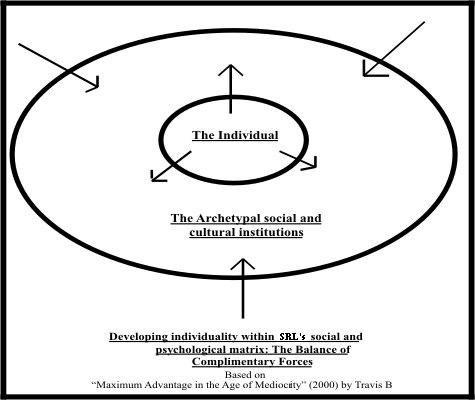
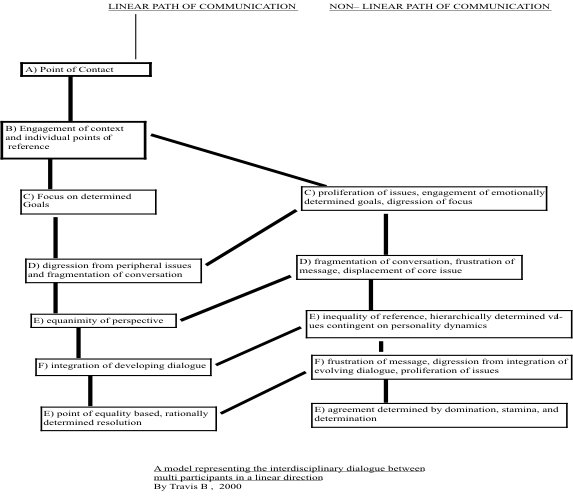
The development of individuality has historically been defined by societal forces and trends (see previous post for diagram). In order to develop a sound and independent frame set through which to pursue cultural transcendence, we require the stamina and insight made available through social criticism. As argued at the beginning of this introduction, our personal and collective Shadow have permitted the exploitation of our self-constructed and self-perceived vulnerabilities. SRL discusses not only how we are manipulated as individuals, but discusses specific societal myths that are utilized for this purpose[13].
With the anti-natural perpetuation of these false beliefs we loose the opportunity to extricate ourselves from this vicious circle, to be lost in a dreary haze of distorted meaning and frustrated visions. Our society’s “stage of proximal growth” has been afforded after most major wars, while those afforded by peace are rarely pursued. The cleansing of our anti-natural instincts and false beliefs is necessary for the genuine individuation of the individual as well as the group. It of course needs to be recognized that to cleanse oneself from the outside in, or from the inside out, is to be regarded as two distinctively separate processes. Cultural and historical movements produce an externally determined expression of the individuation process within a unified, safe, and political context. It is supervised, controlled, defined, as well as determined. As a result the individuation process in this context does not produce genuine equality, self-expression, or question the existing balance of power. When we cleanse ourselves starting from within--the process is selectively and individually determined. It is a private matter for each of us as human beings to explore our identity without the unnecessary influence of the anti-natural archetypes.
[13] The author's most important analysis concerns the myth of "progress". Other examples include "Productivity" in: Chomsky, Noam. Et. Al. The Cold War and the University. NY: The New Press, 1997; or "Meritocracy" and "Seniority" in: Albott, Andrew. The System of Professions: An Essay on the Division of Expert Labor. Chicago: University of Chicago Press, 1988.
Wednesday, August 31, 2005


Tuesday, August 30, 2005
Introduction to Maximum Advantage Collection by Travis B. Part 10
Developing Individuality: The Balance of Complimentary Forces.
This archetypal, artificial, instinct for self-preservation is the dynamic expression of what SRL calls the "anti-natural". Within this concept SRL explains that an artificial reality is defined as well as perpetuated within the minds of its constituents. Consider the diagram included on the previous page. Within this admittedly simplistic representation lays the core problem. The transmittal of culture, which includes our current as well as historical beliefs, values, and convictions, is manipulated and exploited by the archetypal forces that influence it: this process is what SRL has named "Maximum Advantage". The path of communication[10] (of which this diagram represents albeit simplistically) is determined by the "verbal worlds" as well as the "herd" mentality that responds to it. The artificial archetypal figure- head's self actuated desire for preservation rivals its constituency's needs.
The transmittal of information, in the level of abstract formalism evident in this era, has contributed to the interdependency of the populace on the existing system. The self-preservation instincts of the father and mother archetypes demand the active and willful collaboration of its constituents. This collaboration, itself described as an "anti-natural" instinct by SRL, is facilitated by artificially constructed imagery and symbols. These artificial images and symbols, themselves a representation of the global village in which we are a member, are constructed and defined by the father and mother archetypal figureheads. As one will recognize, this is an exclusively self-serving system, and as SRL argues in his book, bends its constituency's will to the maintenance and preservation of an anti-natural[11] culture. The resulting rules and regulations determine not only the ideologies and goals pursued but also the constraints and demands that will be placed on our "freewill[12]. As the diagram representing the path of communication will show, the transmittal of culture as well as the meaning contained in its imagery and symbols is established within an unbalanced playing field. SRL offers several insights and conclusions regarding how this era can eventually transcend the existing power matrix.
[10] I would argue that communication cannot be quantified or reduced to such a simplistic linear state. This model is only intended to assist with the following argument.
[11] This concept of the "anti-natural", is an interesting concept developed by SRL. It is his contention that the anti-natural is an artificial state resulting from both propaganda and Pavlovian principles.
[12] SRL argues that these are static, and uniformly defined within a given context. Jung's collective unconscious is considered to contain historical as well as current mythological motifs. The difference between the static cultural myths that are promoted in society, and Jung's mythological motifs, is that the prior is essentially unchanging in definition, whereas the latter's meaning is to be defined by a fluid state that incorporates the immediate context and all that implies.
Monday, August 29, 2005
Introduction to Maximum Advantage Collection by Travis B. Part 9
As a dynamic, living, sentient life process that is based on the underlying principles of self- preservation, we are all predisposed to protect ourselves. Against fear, aggression, violence, or subjugation, we continue to strive towards our own self- preservation. A community operates on similar principles. Taking on the dynamic life-like characteristics of its constituents, a community as the operational mother archetype is solely created for the self-preservation of its members. As a guiding operational principle, this mother archetype governs as well as creates the rules and laws that make up our civilization. These rules and regulations allow thousands, if not millions of people to live together in relative harmony. As international relations expand, and the global village develops in response to each archetypal mothers devouring hunger for products, these overlapping communities require external regulating forces to govern their well being as well.
The father archetype is now born. Benefactor to the mother archetype's relative power, the father archetype influences collaboration and agreement amongst the other global mothers in an effort to maximize our (and their) probability for preservation. As the mothers became more interdependent on their benefactors, the father archetypal governments, it was soon realized that the self-preservation of the father archetype[9] was also essential for our well-being. Without our father, who would provide and protect us from neighboring communities? As a result, the birth of the father archetypal governments on which we have become so interdependent, have also developed a self-preservation instinct. In the end the self-preservation instinct is universal. Whether a dynamic, living, sentient life force, or an artificial archetypal protector, the will to life has transcended necessity as well as logic.
[9] The cathection with the father archetypal figure in this analysis argues for one's need for security, as well as the impoverished process of individuation.
The father archetype is now born. Benefactor to the mother archetype's relative power, the father archetype influences collaboration and agreement amongst the other global mothers in an effort to maximize our (and their) probability for preservation. As the mothers became more interdependent on their benefactors, the father archetypal governments, it was soon realized that the self-preservation of the father archetype[9] was also essential for our well-being. Without our father, who would provide and protect us from neighboring communities? As a result, the birth of the father archetypal governments on which we have become so interdependent, have also developed a self-preservation instinct. In the end the self-preservation instinct is universal. Whether a dynamic, living, sentient life force, or an artificial archetypal protector, the will to life has transcended necessity as well as logic.
[9] The cathection with the father archetypal figure in this analysis argues for one's need for security, as well as the impoverished process of individuation.
Sunday, August 28, 2005
Introduction to Maximum Advantage Collection by Travis B. Part 8
Linear V. Non-Linear Path of Communication.
"Technical morality" taps into the existing framesets of its constituents, us. Similar to our peers, it befriends and negotiates with us in an attempt to persuade its audience to become believers as well as members of its influence. SRL implicitly argues that this "technical morality" usurps and replaces our pre-existing beliefs and values. As this new artificial morality is digested, processed, and integrated into our current mindsets, it becomes more persuasive in directing and developing new modes of thought. We are thus its benefactors as well as its consumers. We eventually learn to contribute to this "technical morality's" development as well as participate in its rabid consumption. This process, which has taken on sentient properties in the respect that it is dynamically responsive to our personal as well as group thought processes, becomes a catalyzing agent and perpetuator of action. Integrated as a natural and biological component of ourselves, this "technical morality" becomes a social matrix not only of the existing cultural and societal structure existing outside of our physical selves, but a psychological matrix that exists and operates within us.
This new artificial morality serves those in power, in both political and corporate positions. It serves to integrate and provide us as a power-base resource for the politicians that want to sell their new self-serving policies to their constituents. It also serves the corporations by persuading us to believe that we need them, want to work for them under any circumstances, as well as consume their products. As a direct and observable representation of "technical morality's" dynamic process, we only have to look at our televisions. The news is contrived to give us sufficient information to keep us occupied while avoiding the real issues at hand[7] . Commercials are produced with the most valuable consumers in mind. Perpetually adjusted and rewritten for optimal efficiency, commercials are based on the operating principle that if the editors can access the viewing audiences internal belief systems in a raw and intrinsically personal way, they can sell us products we do not even need[8].
[7] This premise is essentially similar to arguments made in these texts: Herman, S. Edward and Noam Chomsky. Manufacturing of Consent: the Political Economy of the Mass Media. NY: Pantheon Books, 1988; and Glossner, Barry. The Culture of Fear: Why Americans are Afraid of the Wrong Things. NY: Basic Books, 1999.
[8] See the Frontline Commentary: The Merchants of Cool. Frontline. PBS. Washington. 2001.
Saturday, August 27, 2005
Introduction to Maximum Advantage Collection by Travis B. Part 7
This brings us back to the discussion of morality. When the word morality is discussed I have argued that it usually carries with it religious connotations. American society is starting to understand that there is a difference between morality and spirituality, where one is religious and the other can be secular. SRL further proposes that morality can be further differentiated from itself in the sense that there can be both a religious as well as a “technical” morality. This “technical morality”, as SRL calls it, is superimposed upon the existing social structure, integrating and expanding upon the pre-existing social fabric. Dynamic and flexible like a biological or sentient being, this “technical morality” is responsive to the pre-existing social structure’s thoughts, beliefs, and values. Although the concept of a “technical morality” is to be elaborately explained in section 2, it is clear that it now, once introduced, becomes an ingrained and permanent part of our cultural and societal structure.
As a social matrix, “technical morality” integrates and contributes to the development of society’s personal, professional, and political framesets. These framesets, as operational schemas devised as heuristic devices to order and organize our lives, are an important part of how we define ourselves, and society. The caution that SRL implicitly communicates throughout this book is that the “technical morality” social matrix is artificial and contrived. It is man made, and more specifically, those in power have manufactured it, in an effort to maintain that power.
As a social matrix, “technical morality” integrates and contributes to the development of society’s personal, professional, and political framesets. These framesets, as operational schemas devised as heuristic devices to order and organize our lives, are an important part of how we define ourselves, and society. The caution that SRL implicitly communicates throughout this book is that the “technical morality” social matrix is artificial and contrived. It is man made, and more specifically, those in power have manufactured it, in an effort to maintain that power.
Friday, August 26, 2005
Introduction to Maximum Advantage Collection by Travis B. Part 6
I remember when I was sponsoring a 6-year-old boy in Ecuador, named Manuel. Every month for 5 years I mailed a check to subsidize his family’s monthly expenses. Every year the organization mailed me a card informing me of the opportunity and date to send Manuel a personal Christmas card, birthday card, Easter card, etc. It was assumed that this opportunity would serve to maintain a personal connection with my sponsored child, as well as to give him something out of the ordinary that would validate him as a valued individual (as well as perpetuate the prosperity of Christianity in Ecuador). Each year the organization also mailed a letter personally written by Manuel, along with a standardized card from the organization inviting me to write to Manuel in response. In the organization’s standardized card it was requested that I do not tell Manuel of any of my new purchases. It was the organization’s belief that this would make Manuel jealous, and subsequently feel negatively and disappointed of his surroundings. It was apparently assumed by the organization, of which I fairly well have no reason to disagree, that Manuel has very little experience with the American culture. Clearly in any child’s life there is the experiential desire for fun and games. In the American child’s life this includes objects that only money can buy, something that Manuel’s family, earning an average of $20.00 per month can probably not provide.
With the introduction of these Christian charity groups into South America, the indigenous people were introduced to a metaphysical and symbolic language that was independent of their previous life experience. Before the introduction of Christianity these people presumably had little if any previous knowledge of its primary beliefs. After it was introduced by missionaries, as well as various charity organizations, this all changed. What this story provides is an example of “Relative Deprivation”. Within this social construct theory, it is generally believed that an individual or group that lacks a relative level of security, wealth, or power, etc., is usually unaware of this deficiency unless they have something by which to compare its current situation. Without the introduction of Christianity or the Christian charitable organization, these people were unaware of this branch of religion or the possibility to live differently than previous generations. This example of course is not intended to argue that the introduction of these American social constructs is inappropriate; it is merely used to establish the fact that people are usually unaware of what they have never experienced. As a result, people are unaware of what they are missing. This is not necessarily a bad thing.
With the introduction of these Christian charity groups into South America, the indigenous people were introduced to a metaphysical and symbolic language that was independent of their previous life experience. Before the introduction of Christianity these people presumably had little if any previous knowledge of its primary beliefs. After it was introduced by missionaries, as well as various charity organizations, this all changed. What this story provides is an example of “Relative Deprivation”. Within this social construct theory, it is generally believed that an individual or group that lacks a relative level of security, wealth, or power, etc., is usually unaware of this deficiency unless they have something by which to compare its current situation. Without the introduction of Christianity or the Christian charitable organization, these people were unaware of this branch of religion or the possibility to live differently than previous generations. This example of course is not intended to argue that the introduction of these American social constructs is inappropriate; it is merely used to establish the fact that people are usually unaware of what they have never experienced. As a result, people are unaware of what they are missing. This is not necessarily a bad thing.
Thursday, August 25, 2005
Introduction to Maximum Advantage Collection by Travis B. Part 5
This is where we come back to Vygotsky’s “stage of proximal growth”. In order to improve upon our current societal condition we not only require a thorough knowledge
of what has produced our current condition, but also a thorough understanding of what continues to perpetuate it; Ultimately, what constrains its growth. This knowledge is quintessential to transcend our current stage of cognitive and social development[6]. It is within this point that SRL argues it is our ‘morality’ that produced our current societal condition; a condition that SRL argues is ripe for exploitation- to the “Maximum Advantage“ of others.
SRL argues that the overriding rules that govern our will to action have been corrupted and tainted by the corporate and political powers that consequently feed society. The things upon which we are interdependent to survive. Similar to the ecological cycle that scientists have found to exist between plants, birds, mammals, and aquatic life, humans are dependent on one another as well as corporations for work, products, culture, and the subsequent support and nourishment of the community. Within this corporate-human cycle, exist the institutions that perpetuate and maintain our culture.
[6] Our cultural and societal growth is stated to be similar to our current stage of cognitive and social development. This is based on the premise that cognitive and society develop at a similar rate for the “herd”.
of what has produced our current condition, but also a thorough understanding of what continues to perpetuate it; Ultimately, what constrains its growth. This knowledge is quintessential to transcend our current stage of cognitive and social development[6]. It is within this point that SRL argues it is our ‘morality’ that produced our current societal condition; a condition that SRL argues is ripe for exploitation- to the “Maximum Advantage“ of others.
SRL argues that the overriding rules that govern our will to action have been corrupted and tainted by the corporate and political powers that consequently feed society. The things upon which we are interdependent to survive. Similar to the ecological cycle that scientists have found to exist between plants, birds, mammals, and aquatic life, humans are dependent on one another as well as corporations for work, products, culture, and the subsequent support and nourishment of the community. Within this corporate-human cycle, exist the institutions that perpetuate and maintain our culture.
[6] Our cultural and societal growth is stated to be similar to our current stage of cognitive and social development. This is based on the premise that cognitive and society develop at a similar rate for the “herd”.
Wednesday, August 24, 2005
Introduction to Maximum Advantage Collection by Travis B. Part 4
Most people, when they hear the world “moral” or “morality”, anticipate or reflect on its usual religious implications: to be good; to be righteous; to support others. Morality even in its vaguest of terms conveys the essence of goodwill. Even in the respect that goodwill carries the connotations of a relative definition, it is maintained within a philosophical and attitudinal frame of reference that continues to be correlated with humanity. Humanity as a subset of goodwill contains the implications of family and community, which subsequently rely on our instinctual drive to protect, nurture, and procreate. As a result morality, goodwill, and humanity can be argued to provide a frame of reference that intrinsically promotes self- preservation.
Although an admittedly indirect argument, morality can be argued to be a platform for our own individual as well as group preservation. This will to preservation is a main theme throughout this book, with a direct correlation with Jung’s shadow archetype. You may ask yourself, “Clearly you can not have a fine red wine with treif? It simply would not taste good!” I argue that you can. It may not taste good, but it must be experienced in order to develop any such distinction[5]. Similar to SRL’s correlation of the will to preservation with the cultural- shadow archetype, it may taste poor to the unsophisticated intellect, but is essential for us to properly process and digest our current cultural and societal condition- if we are ever to transcend it.
[5] This jest is similar to the following discussion of the concept, “relative deprivation”. Only the intellectually inexperienced take the given word for-granted. An argument consistently inferred in SRL’s book.
Although an admittedly indirect argument, morality can be argued to be a platform for our own individual as well as group preservation. This will to preservation is a main theme throughout this book, with a direct correlation with Jung’s shadow archetype. You may ask yourself, “Clearly you can not have a fine red wine with treif? It simply would not taste good!” I argue that you can. It may not taste good, but it must be experienced in order to develop any such distinction[5]. Similar to SRL’s correlation of the will to preservation with the cultural- shadow archetype, it may taste poor to the unsophisticated intellect, but is essential for us to properly process and digest our current cultural and societal condition- if we are ever to transcend it.
[5] This jest is similar to the following discussion of the concept, “relative deprivation”. Only the intellectually inexperienced take the given word for-granted. An argument consistently inferred in SRL’s book.
Tuesday, August 23, 2005
Introduction to Maximum Advantage Collection by Travis B. Part 3
We may have the genetic and heritable potential to acquire verbal and written language as a form of communication, but similar to all forms of knowledge it has to be learned. Consider algebra for example. In order to understand exponential functions or polynomials, it is usually considered necessary to acquire at least a fundamental understanding of the mathematical precursors to this subject. As a cognitive task, algebra requires the intellectual and conceptual foresight capable of understanding as well as interpreting this symbolic, mathematical language. The development of cognition, especially in its most fundamental forms, is intrinsically dependent on what Igor Vygotsky[2] describes in Language and Thought as “The Stage of Proximal Growth”. In this developmental theory, Vygotsky explains that the development of cognition is a fairly linear process. Vygotsky believed that each fundamental cognitive stage was merely the predecessor to its next, and that it is necessary to develop these in succession in order to properly comprehend the ‘object’ of study. Language is a symbolic system that contains a complex system of rules and laws governing its use. Words contribute meaning to our experience as well as help us develop meaning for the objects we use, and this skill requires the sequential[3] development of our cognitive and conceptual thinking skills. Although Vygotsky’s study of children revolved more around their cognitive, thus biological development, I believe that the concept of “the stage of proximal growth” can effectively be utilized to explain SRL’s conception of the developing cultural and moral identity.
The development of a moral identity is dependent on one’s surrounding culture. Without role modeling from an externalized source, the concept of morality merely exists within a vacuum. For sake of argument I add that the knowledge of religion is (usually) acquired through an external source; whether it is a peer or a proselytizer, it still requires an external “object” to impart this knowledge. It can be further be argued that this morality needs to be upheld and sustained in order to be reinforced. An individual moral system requires this continuity[4]. With the external “object” or individual introduced to impart this knowledge, the information is not only now made available but it has been transformed into a social construct. It is now a characteristic of the social environment, and in most instances can be considered to be a representative characteristic of its adhering constituents. The point is that now a cultural frame of reference is being defined, and this frame will now contain the small fragment of information imparted to you.
[2] Vygotsky, L.S. Thought and Language. Ed. Alex Kozulin. Cambridge Mass: MIT Press, 1986.
[3] (See Below) Sequential does not necessarily imply a rigid system.
[4] A conflicting moral set would negate the probability of its effective and complete integration. This continuity may be supplied by a multi-participant system. As a result it may appear chaotic to the outsider, but consistently maintain the exact rate of information discharge as the source.
The development of a moral identity is dependent on one’s surrounding culture. Without role modeling from an externalized source, the concept of morality merely exists within a vacuum. For sake of argument I add that the knowledge of religion is (usually) acquired through an external source; whether it is a peer or a proselytizer, it still requires an external “object” to impart this knowledge. It can be further be argued that this morality needs to be upheld and sustained in order to be reinforced. An individual moral system requires this continuity[4]. With the external “object” or individual introduced to impart this knowledge, the information is not only now made available but it has been transformed into a social construct. It is now a characteristic of the social environment, and in most instances can be considered to be a representative characteristic of its adhering constituents. The point is that now a cultural frame of reference is being defined, and this frame will now contain the small fragment of information imparted to you.
[2] Vygotsky, L.S. Thought and Language. Ed. Alex Kozulin. Cambridge Mass: MIT Press, 1986.
[3] (See Below) Sequential does not necessarily imply a rigid system.
[4] A conflicting moral set would negate the probability of its effective and complete integration. This continuity may be supplied by a multi-participant system. As a result it may appear chaotic to the outsider, but consistently maintain the exact rate of information discharge as the source.
Monday, August 22, 2005
Introduction to Maximum Advantage Collection by Travis B. Part 2
As a representation of the repressed components of an individual’s personality, the Shadow[1] archetype contains a litany of undesirable and unprocessed drives. These drives stem from the fragmented contents of one’s conscious life. As one experiences their culturally or self-perceived weaknesses, whether based on an objective and valid assessment, or the subjective inferential appraisal of one‘s potential, the resulting tension is determined by one’s ability to process or repress the experienced drive (or tension). Although there are clearly various unstated contingencies that affect this process, such as self esteem, sense of self-efficacy, actual competency, as well as external support (etc.), the result is the same: actively processing and integrating the given material or the active rejection or denial of the content with the subsequent repression.
The development of a personal identity requires nurturance and time. The baby’s cognitive development is in many instances directly correlated with their biological age. With the acquisition of more complex cognitive precepts the infant is progressively capable of grasping newer and more complex ideas. When a child is only several months old it does not understand that an object continues to exist even though it may not be present. As the child grows older they not only become more familiar with the principles of object constancy, in which the same object still remains even if not seen, they also acquire increasing knowledge of shape and size, texture, use, and meaning.
[1] I consider the use of SRL’s placement of the shadow archetype, as well as my use of the Father and Mother archetypes in subsequent pages, to represent fundamental social and institutional patterns. As macro-systems they of course are generalized. The image of the Jungian archetype is employed as a result of its sentient properties. This artificial sentience is the result of the people that influence its development. For further fascinating reading on the Shadow archetype see: Henderson, Joseph. Shadow and the Self: Selected Papers in Analytical Psychology. Illinois: Chiron Publishing,1990.
The development of a personal identity requires nurturance and time. The baby’s cognitive development is in many instances directly correlated with their biological age. With the acquisition of more complex cognitive precepts the infant is progressively capable of grasping newer and more complex ideas. When a child is only several months old it does not understand that an object continues to exist even though it may not be present. As the child grows older they not only become more familiar with the principles of object constancy, in which the same object still remains even if not seen, they also acquire increasing knowledge of shape and size, texture, use, and meaning.
[1] I consider the use of SRL’s placement of the shadow archetype, as well as my use of the Father and Mother archetypes in subsequent pages, to represent fundamental social and institutional patterns. As macro-systems they of course are generalized. The image of the Jungian archetype is employed as a result of its sentient properties. This artificial sentience is the result of the people that influence its development. For further fascinating reading on the Shadow archetype see: Henderson, Joseph. Shadow and the Self: Selected Papers in Analytical Psychology. Illinois: Chiron Publishing,1990.
Sunday, August 21, 2005
Introduction to Maximum Advantage Collection by Travis B. Part 1
"..all...attempts have proved singularly ineffective, and will do so long as we try to convince ourselves and the world that it is only they (i.e., our opponents) who are wrong. It would be much more to the point for us to make a serious attempt to recognize our shadow and its nefarious doings. . If we could see our shadow (the dark side of our nature), we should be immune to any moral and mental infection and insinuation. As matters now stand, we lay ourselves open to every infection, because we are really doing practically the same thing as they. Only we have the additional disadvantage that we neither see nor want to understand what we ourselves are doing, under the cover of good manners."
(Carl Jung in Man and his Symbols, p. 73)
Carl Jung's above explanation of the Shadow archetype proposes his belief that man's search for meaning is directly inhibited by his own natural, and repressed conflicts. These conflicts have an influential and in many instances irrepressible influence on our conscious thought and action. Our ability to overcome our own individual or cultural shadow requires not only the knowledge of our culturally and self- perceived weaknesses, but the integration of these characteristics into our conscious and operational schemas. What this extract does not properly convey is Jung's conception of the archetype as the symbolic and historical manifestation of our subconscious contents. Jung believed that through dreams these symbols, or archetypes, present themselves as a representational mental image of our repressed thoughts, feelings, memories, heritage, and beliefs. With the appearance of the shadow, as well as other archetypes, Jung believed that he was then able to interpret the meaning of his client's dream and consequently assist them in processing their repressed conflicts.
The crux of SRL's argument, from the first section of his book, rests on the recognition and acknowledgment of Jung's shadow archetype as an influence behind our culture's development. SRL does not propose that culture is represented within the archetypal imagery of the collective unconscious', but instead utilizes the translational platform of the archetype to convey certain social movements that have been overtly observed within the realm of historical development. As an expression of these currents, our culture's archetypal shadow is, according to SRL, a direct expression of the "Herd" (or group) mentality that governs society's thought, beliefs, and actions.
(Carl Jung in Man and his Symbols, p. 73)
Carl Jung's above explanation of the Shadow archetype proposes his belief that man's search for meaning is directly inhibited by his own natural, and repressed conflicts. These conflicts have an influential and in many instances irrepressible influence on our conscious thought and action. Our ability to overcome our own individual or cultural shadow requires not only the knowledge of our culturally and self- perceived weaknesses, but the integration of these characteristics into our conscious and operational schemas. What this extract does not properly convey is Jung's conception of the archetype as the symbolic and historical manifestation of our subconscious contents. Jung believed that through dreams these symbols, or archetypes, present themselves as a representational mental image of our repressed thoughts, feelings, memories, heritage, and beliefs. With the appearance of the shadow, as well as other archetypes, Jung believed that he was then able to interpret the meaning of his client's dream and consequently assist them in processing their repressed conflicts.
The crux of SRL's argument, from the first section of his book, rests on the recognition and acknowledgment of Jung's shadow archetype as an influence behind our culture's development. SRL does not propose that culture is represented within the archetypal imagery of the collective unconscious', but instead utilizes the translational platform of the archetype to convey certain social movements that have been overtly observed within the realm of historical development. As an expression of these currents, our culture's archetypal shadow is, according to SRL, a direct expression of the "Herd" (or group) mentality that governs society's thought, beliefs, and actions.
Saturday, August 20, 2005
Announcement
Now that Neither the Government Nor the Population 6th Draft has been posted in its entirity, the following topics will be presented in the coming weeks:
Introduction to Maximum Advantage Collection by Travis B.
On This Modern Warrior Archetype
Excerpts from Anarchists in the Spanish Revolution by José Pierats
Discussion of 4GW and the Information Arrow by Greg Wilcox
Afterwards, Neither the Government Nor the Population 7th Draft will then begin.
Introduction to Maximum Advantage Collection by Travis B.
On This Modern Warrior Archetype
Excerpts from Anarchists in the Spanish Revolution by José Pierats
Discussion of 4GW and the Information Arrow by Greg Wilcox
Afterwards, Neither the Government Nor the Population 7th Draft will then begin.
Friday, August 19, 2005
Neither the Government Nor the Population (6th Draft)
1995 - 1997
A PDF version is available HERE.
Table of Contents
Introduction
Chapter 1
Chapter 2
Chapter 3
Chapter 4
Chapter 5
Chapter 6
Appendices
A PDF version is available HERE.
Table of Contents
Introduction
Chapter 1
Chapter 2
Chapter 3
Chapter 4
Chapter 5
Chapter 6
Appendices
Thursday, August 18, 2005
NTGNTP (6th Draft): BIBLIOGRAPHY
Partial Bibliography
(in no particular order.)
(For a more complete Bibliography, which includes those below in greater detail, from the Maximum Advantage Collection go HERE.
i. Publishers have been omitted.
ii. Publication Date is often Overlooked.
iii. Etc.
1. Jaques Ellul: The Technological Society 1964; Propaganda 1966; The Political Illusion 1967 (these dates indicate English translations)
2. George Orwell: Animal Farm; 1984
3. Steven Solomon: The Confidence Game 1995
4. Friedrich Nietzsche (Translated by Walter Kaufman): The Will to Power; Beyond Good And Evil; Thus Spoke Zarathustra; Twilight of the Idols; The Antichrist; et al.
5. Niccolo Machiavelli: The Prince; The Discourses
6. Edward Abbey: Desert Solitaire; The Monkey Wrench Gang; Good News; The Brave Cowboy; Fire on the Mountain; Fool's Progress; Abbey's Road; Down the River; The Journey Home; et al.
7. Franz Kafka: The Trial
8. Werner Heisenberg: Physics and Philosophy; et al.
9. Jim Goad: (with Debbie Goad) Answer Me! #1-4 (self-published); The Redneck Manifesto 1997
10. S I Hayakawa: Language in Thought and Action
11. Adam Parfrey: Apocalypse Culture; Cult Rapture
12. Martin Sprouse: Sabotage in the American Workplace
13. Hunter S Thompson: Hell's Angels; The Great Shark Hunt; Fear and Loathing on the Campaign Trail: 1972; et al.
14. The Baffler #6-9
15. Robert Hughs: Culture of Complaint
16. Jacob Holdt: American Pictures
17. David S Saxon: Elementary Quantum Mechanics
18. Alexander Cockburn: The Nation, "Beat the Devil"
19. P A Vesilind, J J Pierce, R F Weiner: Environmental Pollution and Control
20. F W Sears, G L Salinger: Thermodynamics, Kinetic Theory and Statistical Mechanics
21. Neil Howe, Bill Strause: 13th Gen
22. Anthony Burgess: A Clockwork Orange
23. Upton Sinclair: The Jungle
24. Walter Lefeber: Inevitable Revolutions
25. Salmon Rushdie: The Satanic Verses
26. Gilbert Shelton: The Fabulous Furry Freak Brothers
27. Robert Heinlein: Farnam's Freehold; Stranger in a Strange Land; The Moon is a Harsh Mistress (TANSTAAFL)
28. Darrel Huff: How to Lie with Statistics
29. George Gamov: Mr. Thomkins in Wonderland et al.
End of Appendices.
End of 6th Draft.
(in no particular order.)
(For a more complete Bibliography, which includes those below in greater detail, from the Maximum Advantage Collection go HERE.
i. Publishers have been omitted.
ii. Publication Date is often Overlooked.
iii. Etc.
1. Jaques Ellul: The Technological Society 1964; Propaganda 1966; The Political Illusion 1967 (these dates indicate English translations)
2. George Orwell: Animal Farm; 1984
3. Steven Solomon: The Confidence Game 1995
4. Friedrich Nietzsche (Translated by Walter Kaufman): The Will to Power; Beyond Good And Evil; Thus Spoke Zarathustra; Twilight of the Idols; The Antichrist; et al.
5. Niccolo Machiavelli: The Prince; The Discourses
6. Edward Abbey: Desert Solitaire; The Monkey Wrench Gang; Good News; The Brave Cowboy; Fire on the Mountain; Fool's Progress; Abbey's Road; Down the River; The Journey Home; et al.
7. Franz Kafka: The Trial
8. Werner Heisenberg: Physics and Philosophy; et al.
9. Jim Goad: (with Debbie Goad) Answer Me! #1-4 (self-published); The Redneck Manifesto 1997
10. S I Hayakawa: Language in Thought and Action
11. Adam Parfrey: Apocalypse Culture; Cult Rapture
12. Martin Sprouse: Sabotage in the American Workplace
13. Hunter S Thompson: Hell's Angels; The Great Shark Hunt; Fear and Loathing on the Campaign Trail: 1972; et al.
14. The Baffler #6-9
15. Robert Hughs: Culture of Complaint
16. Jacob Holdt: American Pictures
17. David S Saxon: Elementary Quantum Mechanics
18. Alexander Cockburn: The Nation, "Beat the Devil"
19. P A Vesilind, J J Pierce, R F Weiner: Environmental Pollution and Control
20. F W Sears, G L Salinger: Thermodynamics, Kinetic Theory and Statistical Mechanics
21. Neil Howe, Bill Strause: 13th Gen
22. Anthony Burgess: A Clockwork Orange
23. Upton Sinclair: The Jungle
24. Walter Lefeber: Inevitable Revolutions
25. Salmon Rushdie: The Satanic Verses
26. Gilbert Shelton: The Fabulous Furry Freak Brothers
27. Robert Heinlein: Farnam's Freehold; Stranger in a Strange Land; The Moon is a Harsh Mistress (TANSTAAFL)
28. Darrel Huff: How to Lie with Statistics
29. George Gamov: Mr. Thomkins in Wonderland et al.
End of Appendices.
End of 6th Draft.
Subscribe to:
Posts (Atom)